PART 5
DON'T STRUGGLE WITH POWER
▸▸▸ ENTERING PART 5
You have chosen your power source. You learned how tilt shapes activation, how the body selects its internal engine, and how the right pattern fuels the swing without strain. Part 4 gave you clarity. Now you enter the phase where that clarity is tested under pressure.
Part 5 is not about technique. It is about conflict.
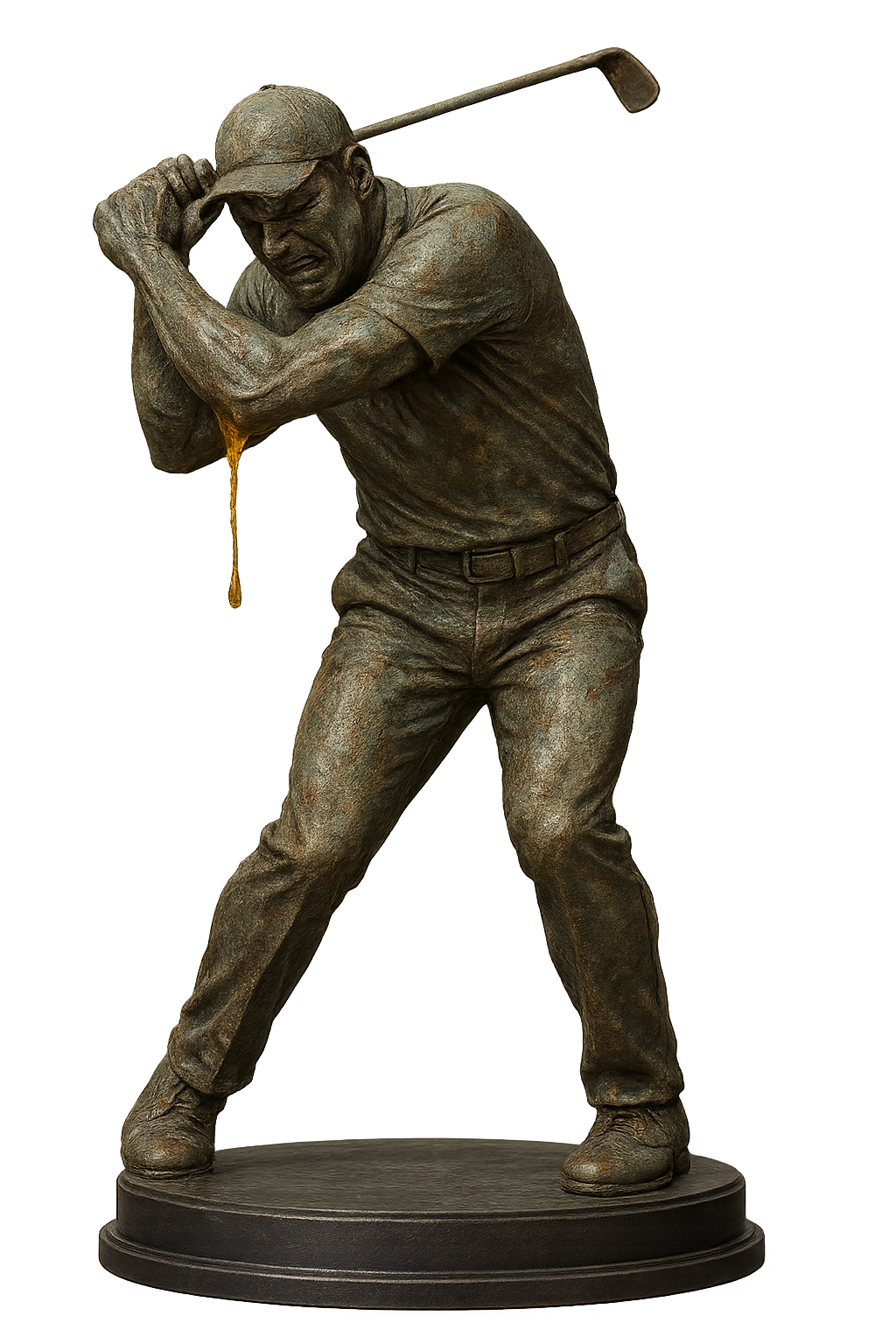
Inside every golfer, two forces compete for control. The hips want speed. The core wants stability. Both believe they are in charge. Only one can lead the swing.
This is the power struggle.
When the hips take over, the swing feels fast but unstable. When the core takes over, the swing feels steady but sometimes restricted. When both fight at the same time, the body twists out of sequence and the strike falls apart.
Part 5 shows you which one is winning inside your body.
This is where you learn how your swing behaves under load, how your posture holds when speed rises, and how your internal engine reacts when the pressure of the downswing arrives. You discover whether your hips are stealing control or whether your core is quietly running the show.
▸▸ STATUS
If you can feel your internal engine activating without confusion, and your tilt pattern stays consistent from setup to release, you are ready for this phase. If your body still switches patterns under speed or your posture collapses when you accelerate, stay with Part 4 until your power source becomes reliable.
Part 5 requires honesty. You are about to find out who really controls your swing.
In Chapter 9, you see the battle between turbo hips and a steady core, and how each one shapes the strike. In Chapter 10, you learn how core in and core out create two different power identities, and how posture either supports or collapses under pressure.
This is where the truth comes out. This is where the power struggle begins.
You may now proceed to Chapter 9.
|
PART 5: DON'T STRUGGLE WITH POWER
Who Really Controls The Swing |
|
| Chapter | Title |
 9
9
|
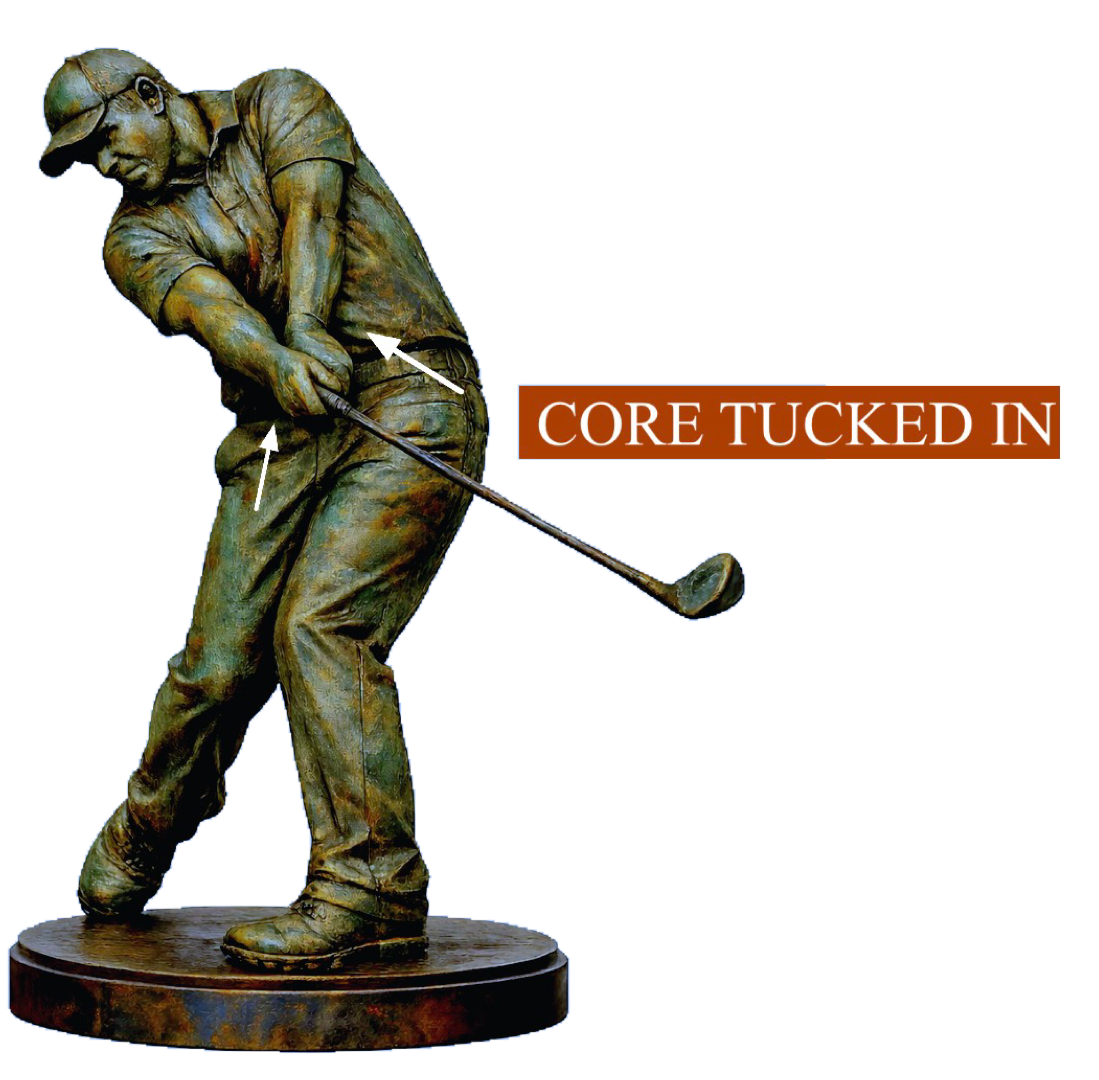
Stop The Hip Hijack
Master the Core to Keep the Swing Controlled
|
 10
10
|
Power vs Posture
Maintain Structure to Transfer Maximum Power
|
"The hip is a high-pressure engine; build a fortress around it."
CHAPTER 9
STOP THE HIJACK
Don't Let Your Game Suffer and Your Body Pay The Price
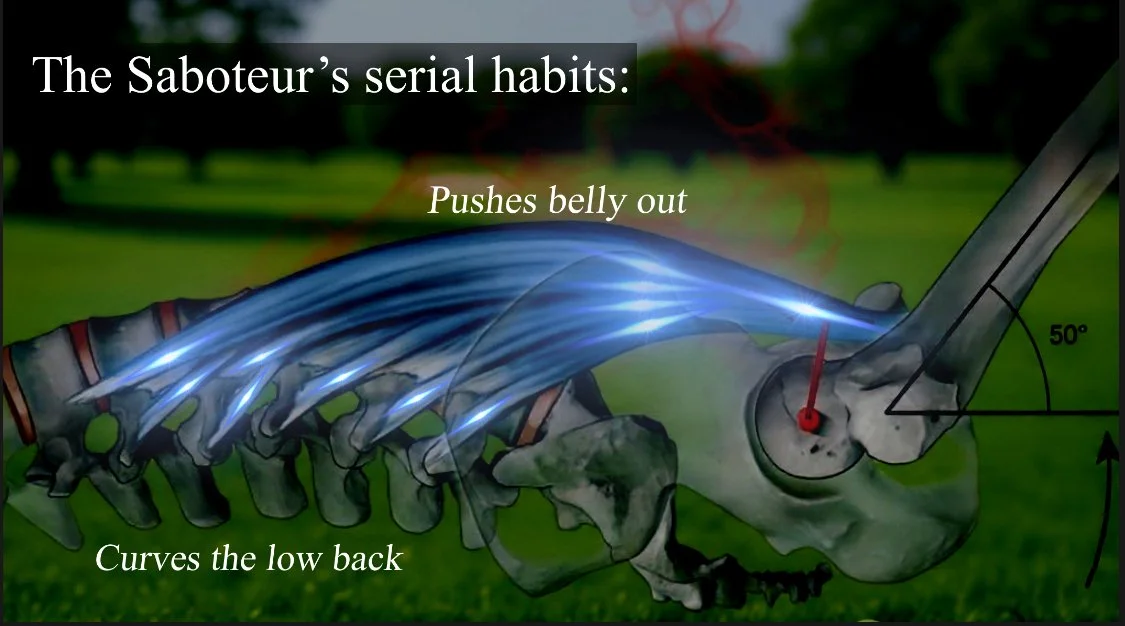
Every golfer has felt the battle between the hips and the core. When the hips fire too early, it leads to hyperextension and stubborn ball slicing. This chapter breaks down the real fight for control inside your body and shows you how to let the core take command so your hips can deliver speed without stealing the entire motion.
I. THE SABOTEUR
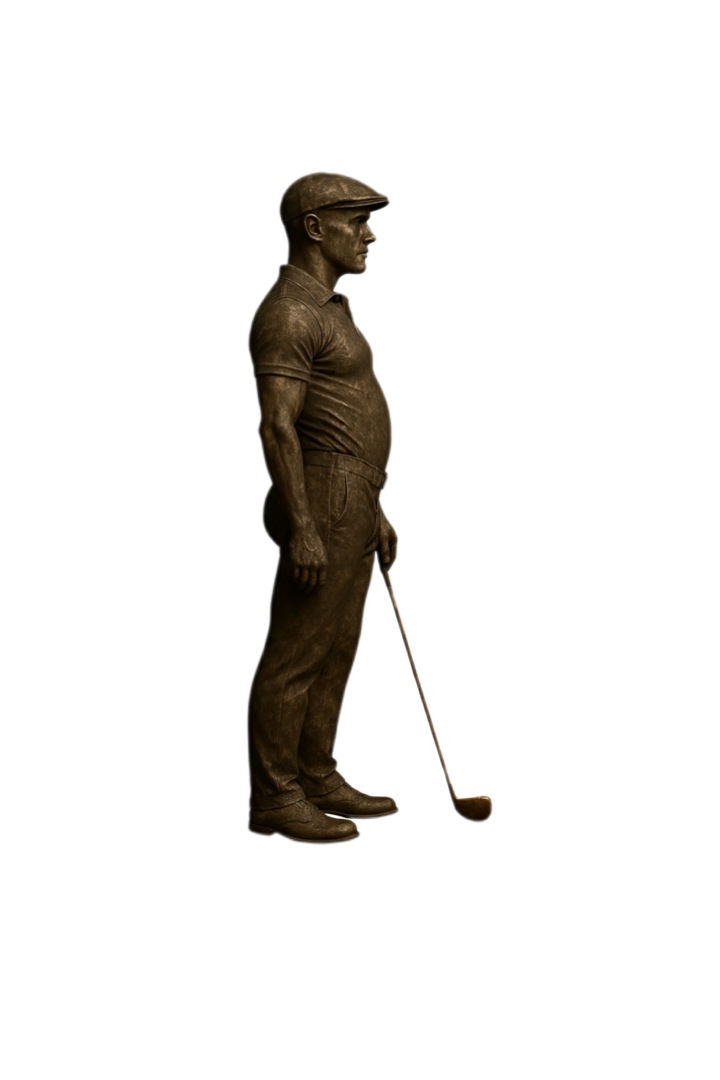
The "Hip Hijack" or Early Extension is the most deceptive move in golf. It occurs when your pelvis suddenly thrusts toward the ball during the downswing, abandoning its posture and hijacking your entire swing sequence.
How the Saboteur Works
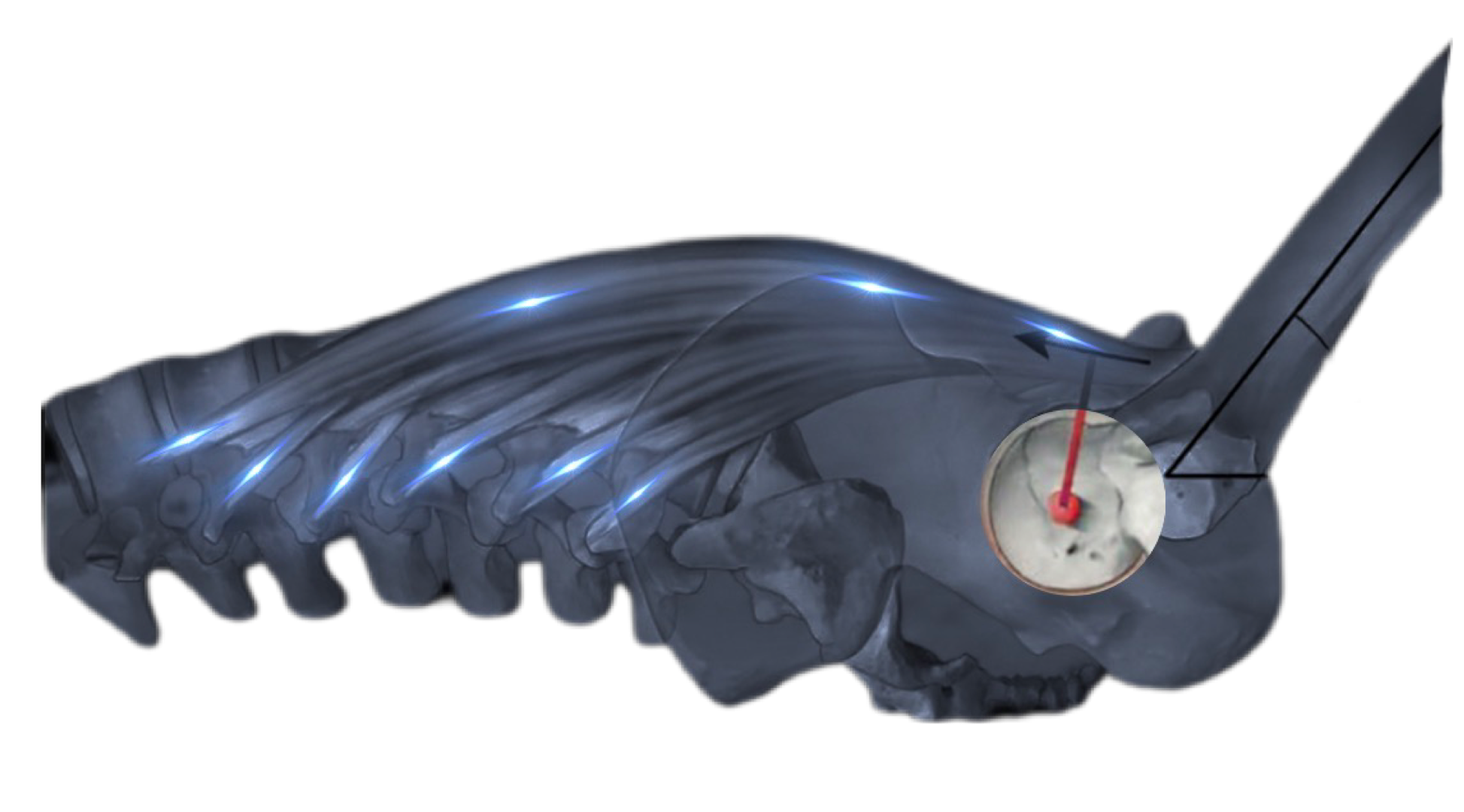
The Saboteur operates by stealing space. When the Epicenter (your core) fails to anchor the pelvis, the hips take the path of least resistance straight forward.
The Space Trap: As your hips move closer to the ball, you effectively delete the room your arms need to swing through. This leaves you trapped, forcing you to stand up and flip the club just to make contact.
The Power Leak: Proper distance comes from rotating around a stable center. A forward thrust wastes all that potential energy, causing a significant drop in clubhead speed.
The Two-Way Miss: Because your body is stuck in the way of your arms, you resort to a block to the right or a desperate hook to the left as your hands try to save the shot at the last millisecond.
Beyond the scorecard, this is a Body Wrecker. It leads to Lower Back Grinding (extreme shear force on the spine), Hip Joint Jamming (labral tears from repetitive thrusting), and violent Knee and Ankle Stress as your weight shifts to your toes instead of your heels.
II. THE EPICENTER
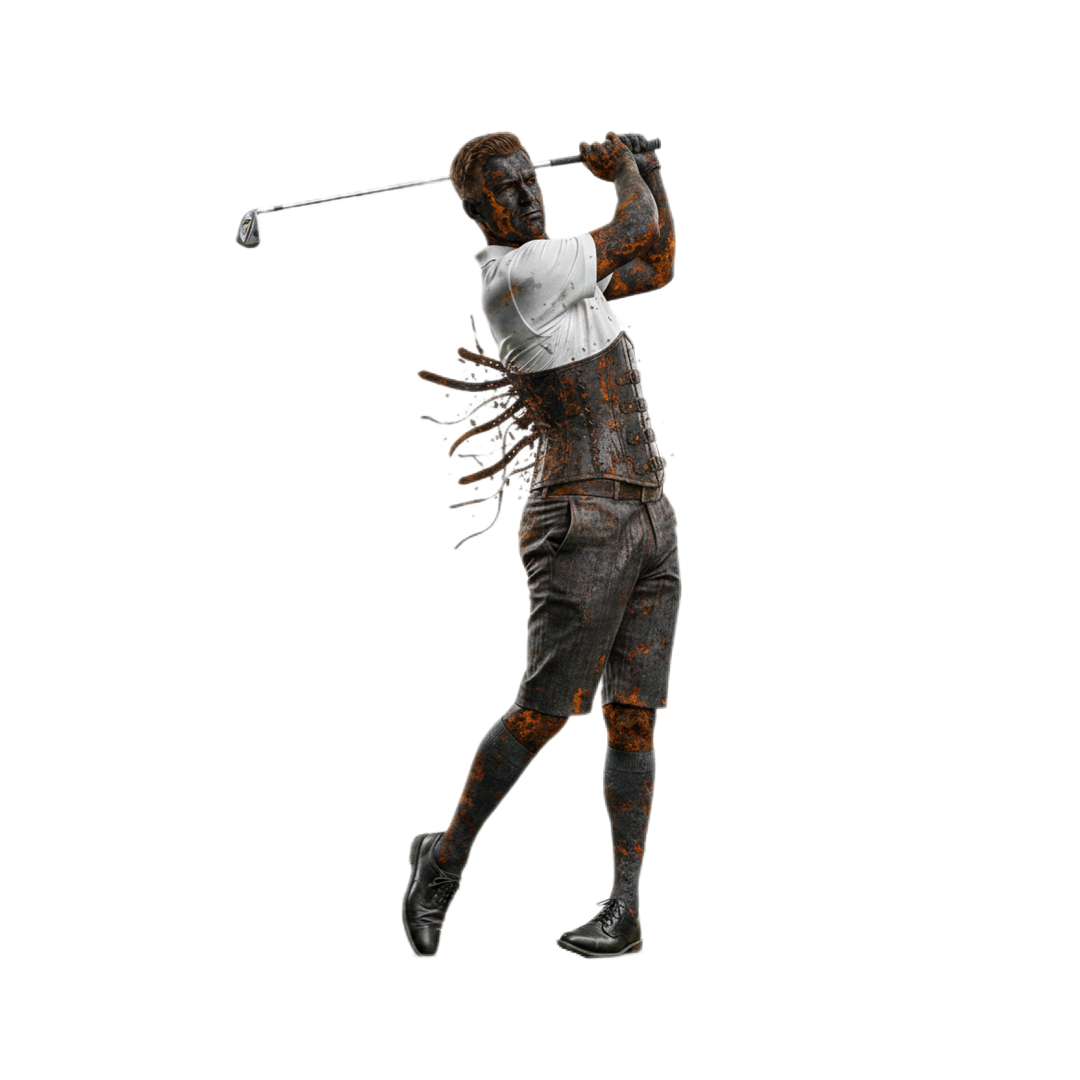
In the world of the Hip Hijack, the Transversus Abdominalis (TVA) is your most vital ally. While most golfers obsess over the six-pack muscles, the elite athlete focuses on the TVA, the deep internal muscle that sits beneath the surface.
The Metaphor: The Living Corset
Imagine a Victorian-era corset made of powerful reactive muscle fibers. This Living Corset wraps entirely around your midsection from your spine to your belly button.
When this corset is loose: Your spine is a stack of wet noodles. This is how the Saboteur takes over. Without the corset tightened, your hips are free to drift and hijack the swing.
When the TVA corset is cinched: Your hips are forced to rotate in place rather than lunging toward the ball.
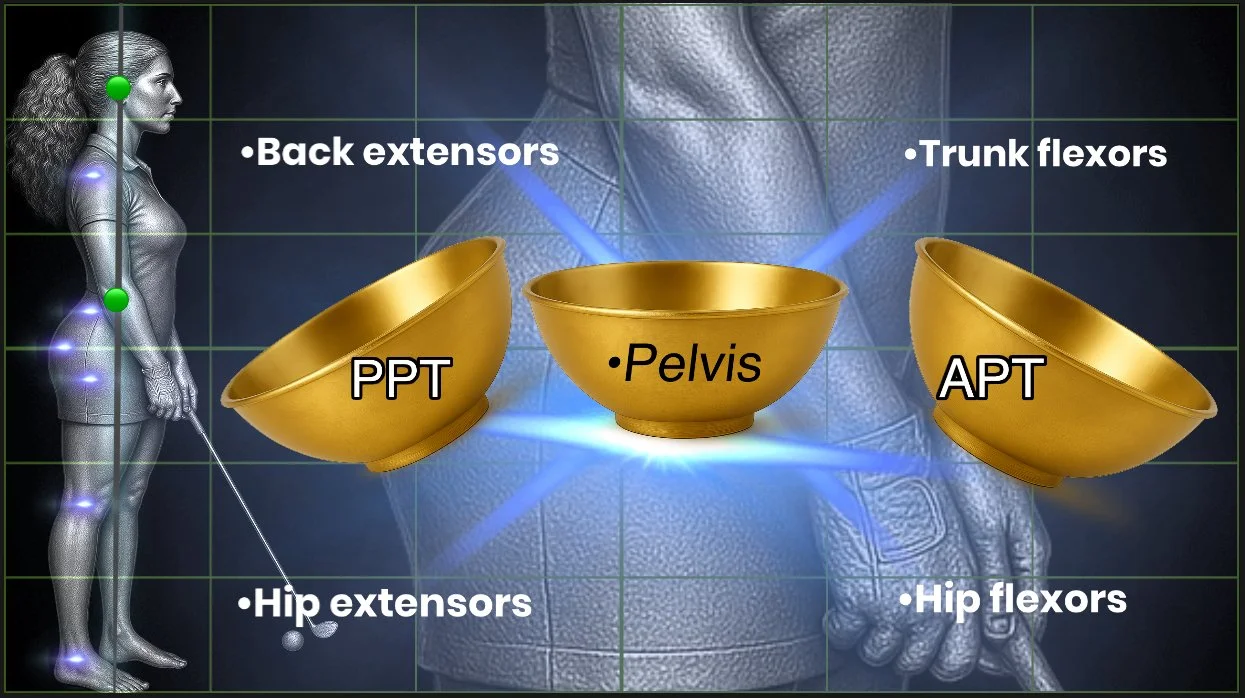
III. POUR THE WATER BACKWARDS
To transform the pelvis from a surging hijacker into a stabilized rotational engine. Your goal is to stop the forward shove and use your core to anchor the hips into spinning power.
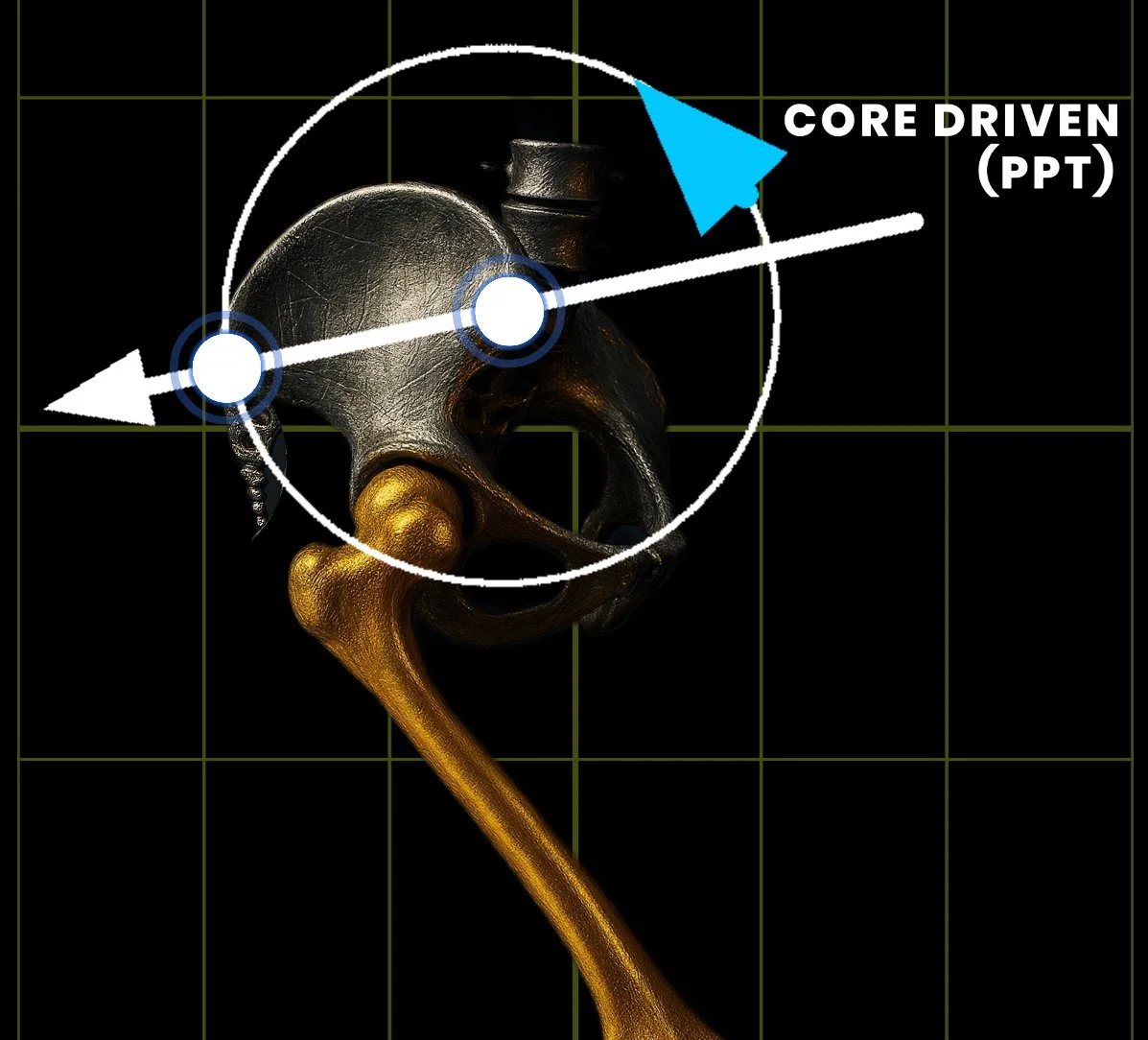
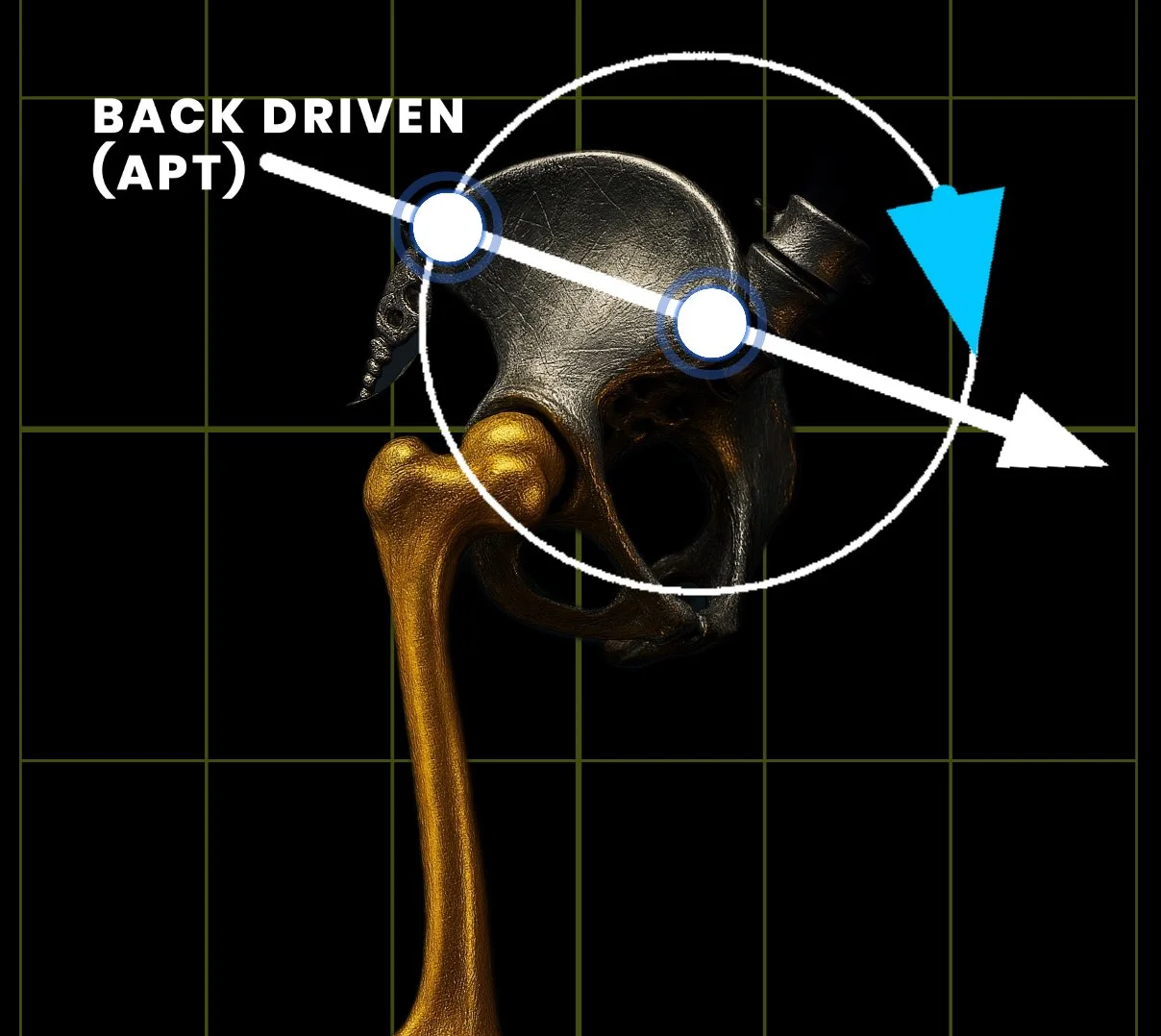
IV. CREATE JOINT SPACE
To prevent the hijack, your core must maintain inward pressure. This pressure acts as an internal anchor, pulling your lead hip backward to create an open lane for your arms to swing through.
V. SPOT THE ERRORS
The Visual Leak: You look like you are standing up or jumping at the ball on video. You frequently hit the ball off the heel or shank it because your body is physically in the way.
The Inside Leak: At the start of the downswing, your stomach goes soft. Without that internal pressure, your hips lurch toward the target line.
The Core Failure: Your lower back is forced to snap upright to stay balanced. This causes the sharp pinch in the groin or deep tightness in the back immediately after practice.
VI. THE CORE FIX
To stop the Hijack, you must cinch the laces. Cinching means pulling tight and securing firmly, like lacing a corset or tightening a saddle strap. For your Epicenter, it draws the deep abdominal wall inward toward your spine to create a full seal of pressure. It is not about holding your breath; it is about locking your internal corset into place.
The Belly Brace: At the top of your swing, tighten your stomach as if you are about to be poked. This locks your Epicenter.
The Wall Push: Imagine a wall behind your butt. As you swing down, push your lead hip back into that wall.
Clear the Lane: Pushing your hip back creates space. Your arms can swing freely without the hands compensating.
Stay Seated: Feel like you are sitting in a chair during impact. This keeps your spine safe and posture intact.
⚖️ Verdict: The Death of the Hijack
The Evidence: The Hip Hijack was caught red-handed stealing space and grinding bone.
The Sentence: The Living Corset (TVA) is hereby activated.
The Ruling: Push the lead hip back into the Wall and keep the Epicenter anchored.
CASE CLOSED.
🔗 Chapter 9 Research: Sequencing & Control
- Neal et al.: Direct-to-abstract link for the study on 3D kinematic sequencing, proving that efficient force starts with proximal hip and trunk acceleration.
- Kwon et al.: Specific study demonstrating how initiating the downswing from the pelvis optimizes energy transfer to the clubhead.
- Hume et al.: Landing page for the study identifying that coordinated trunk and pelvic activation reduces spinal stress while maintaining power.
- Lindsay and Horton: Direct research on trunk motion and muscle activity, confirming that insufficient stabilization leads to excessive compensatory lumbar movement.
- Sorbie et al.: Biomechanical review concluding that superior pelvis-trunk coordination is the key to swing repeatability across all clubs.
- Oliver et al.: Research on rotational efficiency, proving that trunk rotation and weight transfer patterns distinguish skilled golfers.
- Myers et al.: Specific analysis of torso-pelvic separation, demonstrating its direct influence on X-Factor separation and driving performance.
"Build the vault first, then ignite the engine."
CHAPTER 10
POWER VS. POSTURE
Why Speed Fails When Structure Breaks
Every golfer believes they need more power. What they rarely realize is that power is already present but leaking through broken posture. When the spine arches, the pelvis slips, and the core disengages, speed has nowhere to travel. The body compensates with arms, timing collapses, and the lower back absorbs the cost. This chapter exposes the false trade between posture and power and reveals the truth: structure is not a restriction. It is the delivery system. When posture holds, power multiplies.
I. THE MECHANICS SECRET: THE COILED SPRING
A powerful swing is not a swing at all; it is the winding and unwinding of a vertical spring. If you pull the club back with your arms, you are merely moving a stick. If you rotate the club back with your Cylindrical Corset, you are coiling a spring.
The Concept Made Easy:
Imagine a massive, heavy duty industrial spring sitting on a slippery floor. Twist the top without bolting the base, and it slides. No energy is stored.
Most golfers have a loose base because they move their hands first. Move your core a split second before the club to bolt the spring. This creates immediate tension. The spring is now cinched and ready to explode.
Feature Comparison
First Mover
Core-Led Takeaway (Goal): Midsection and lead shoulder.
Arm-Led Takeaway (Trap): Hands and wrists.
Internal Feel
Goal: Cinching tension in obliques.
Trap: Looseness in the middle; fake turn.
Stability
Goal: King (pelvis) stays centered.
Trap: Pelvis sways or slides early.
HOW TO: EXECUTE THE CORE-FIRST TAKEAWAY
The Pre-Cinch: Pull your belly button inward before the club moves to bolt the spring.
The Unified Start: Imagine chest, arms, and midsection as one solid block. When the block moves, the club moves.
The Push: Push the block away using only the ribcage. If your hands do the work, the spring has snapped.
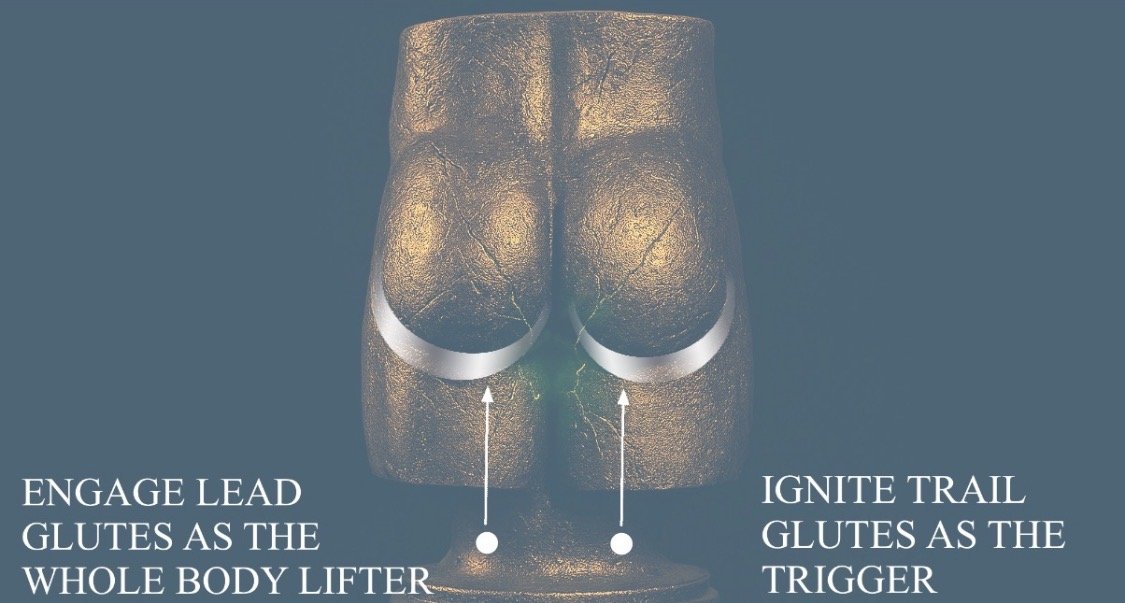
II. THE GLUTES STABILIZES
As the engine starts to wind, the pressure on your base increases. Without the Buttocks Command, the torque of the backswing will pull you off your axis.
The Mechanics Secret:
Your trail buttock is the deadbolt that keeps the engine from sliding off its mounts. You must sit into the anchor to allow the upper body to rotate against a resistant lower body. If your hip slides outward, you aren't coiling a spring; you are just leaning.
HOW TO: LOCK THE TRAIL ANCHOR
Tear the Paper: At address, imagine there is a piece of paper between your feet. Try to tear it in half by pushing your feet outward. This engages your glutes.
Sit and Turn: As the club moves back, feel your trail buttock muscle sit deeper into the ground like you are sitting into a sturdy chair.
The Brace: Stop the backswing the moment you feel your trail buttock is full of tension. This keeps the structure intact.
III. CORE TO GROUND AND BACK AGAIN
Timing is often misunderstood as hitting the ball at the right time. In the core ignition, timing is the pressure shift from the core to the ground and back up.
The Concept Made Easy:
Real power feels heavy in the core and light in the hands. If your hands feel heavy, you are using the wrong engine.
HOW TO: FEEL THE PRESSURE FLOW
The Static Load: Take your backswing and hold the top position for three seconds.
Identify the Leak: If you feel a pull or pinch in your lower back, your corset is loose. You are hanging on your spine, not your muscles.
The Flow: The correct feeling is a massive squeeze in your trail glute and obliques. This proves your posture has held and the spring is loaded.
⚖️ Verdict: The Judgment on Speed
The Evidence: Power without posture is force with nowhere to go. The pursuit of speed through unanchored effort leads to power leaks and catastrophic lower back injury. The Arm‑Led Takeaway and the Hip Slide were found guilty of breaking the kinetic chain.
The Sentence: Effort is replaced by the Coiled Spring principle. The Cylindrical Corset and the Buttocks Anchor are reinstated as the only legal sources of speed.
The Ruling: Only a structure that holds its posture can multiply power. When you lock the trail anchor and feel the pressure flow, you have transformed from a Struggler into a Motion‑Master. You no longer chase speed; you house it.
CASE CLOSED.
🔗 Chapter 10 Research: Postural Mechanics
- Lindsay and Horton (2002): Direct link to the comparison study of spine motion in elite golfers, proving that golfers with low back pain flex their spines more at address and have significantly less trunk rotation.
- Hume, Keogh, and Reid (2005): Specific landing page for the role of biomechanics in maximizing distance, confirming that primary and secondary spinal angles are essential for the summation of force principle.
- Neal et al. (2007): Direct-to-abstract link for the study on body segment sequencing, demonstrating that a proper swing must be initiated by the pelvis and upper trunk to transfer momentum effectively.
- Myers et al. (2008): Direct link to the research on torso-pelvic separation, showing how the orientation and rotation of the pelvis and upper torso dictate ball velocity and X-factor separation.
- Sorbie et al. (2022): Verified direct link to the comprehensive review of biomechanical risk factors, concluding that postural stability and lateral bending control are essential for performance.
- Kwon et al. (2013): Landing page for the analysis of pelvic and trunk rotation timing, confirming that efficient swings rely on early proximal engagement to prevent arm-driven breakdown.