PART 7
Where You Hurt Your Swing And Your Back
▸ ▸ ▸ ENTERING PART 7
You have learned how the engine activates, how it stabilizes, and how it expresses power through every club. Now you enter the part of the doctrine that every golfer feels but few understand.
Part 7 is where the swing and the spine meet.
This is where golfers lose posture, lose sequence, lose power, and often lose their back. Not because they are weak, but because the body is trying to protect itself from instability.
When the core is strong, the spine stays tall, the hips stay supported, and the swing moves with confidence. When the core is weak, the spine collapses, the hips drift, and the swing begins to hurt both performance and the body itself.
Part 7 shows you the truth behind that collapse.
You learn how the strong pattern protects your back, how the weak pattern strains it, and how the structure of your hips and spine can be reinforced through the core. This is not about hitting the ball farther. This is about keeping your body safe while you do it.
▸ STATUS
If you can feel your core activating in motion, and your tilt pattern stays stable under speed, you are ready for this phase. If your posture breaks down when you accelerate or your back tightens during the swing, this part will show you exactly why.
Part 7 requires awareness. You are about to see where your swing protects you and where it hurts you.
In Chapter 14, you learn what a strong, stable core looks and feels like in motion. In Chapter 15, you see how stability breaks and why the spine pays the price. In Chapter 16, you learn how to reinforce your hips and back through the core so your swing becomes both powerful and safe.
This is where you protect your engine. This is where you protect your body. This is where Part 7 begins.
|
PART 7: WHERE YOU HURT YOUR SWING AND YOUR BACK
Spine Health and Stability |
|
| Chapter | Title |
 14
14
|
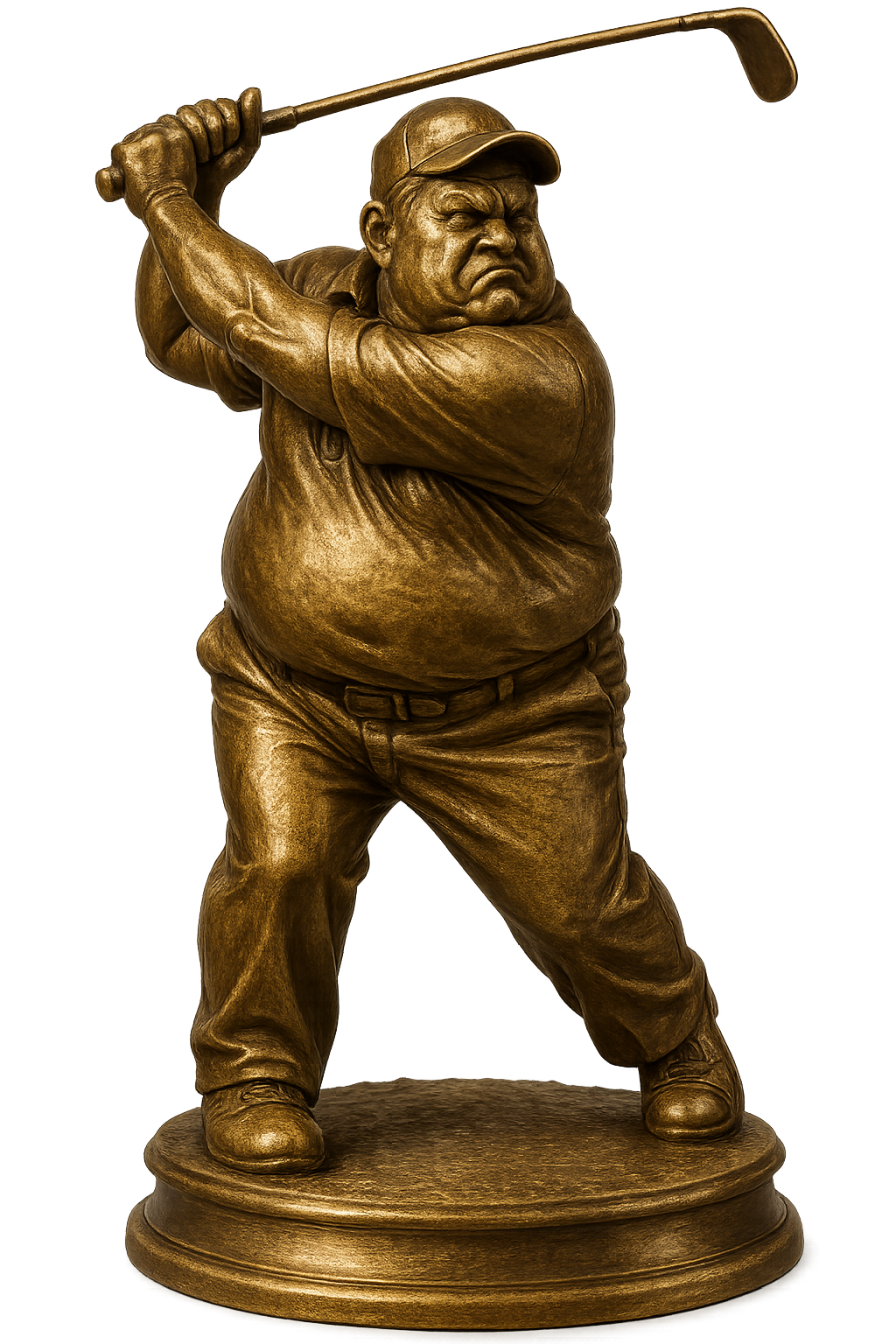
The Weak
How Poor Mechanics Can Compromise Your Spine
|
 15
15
|
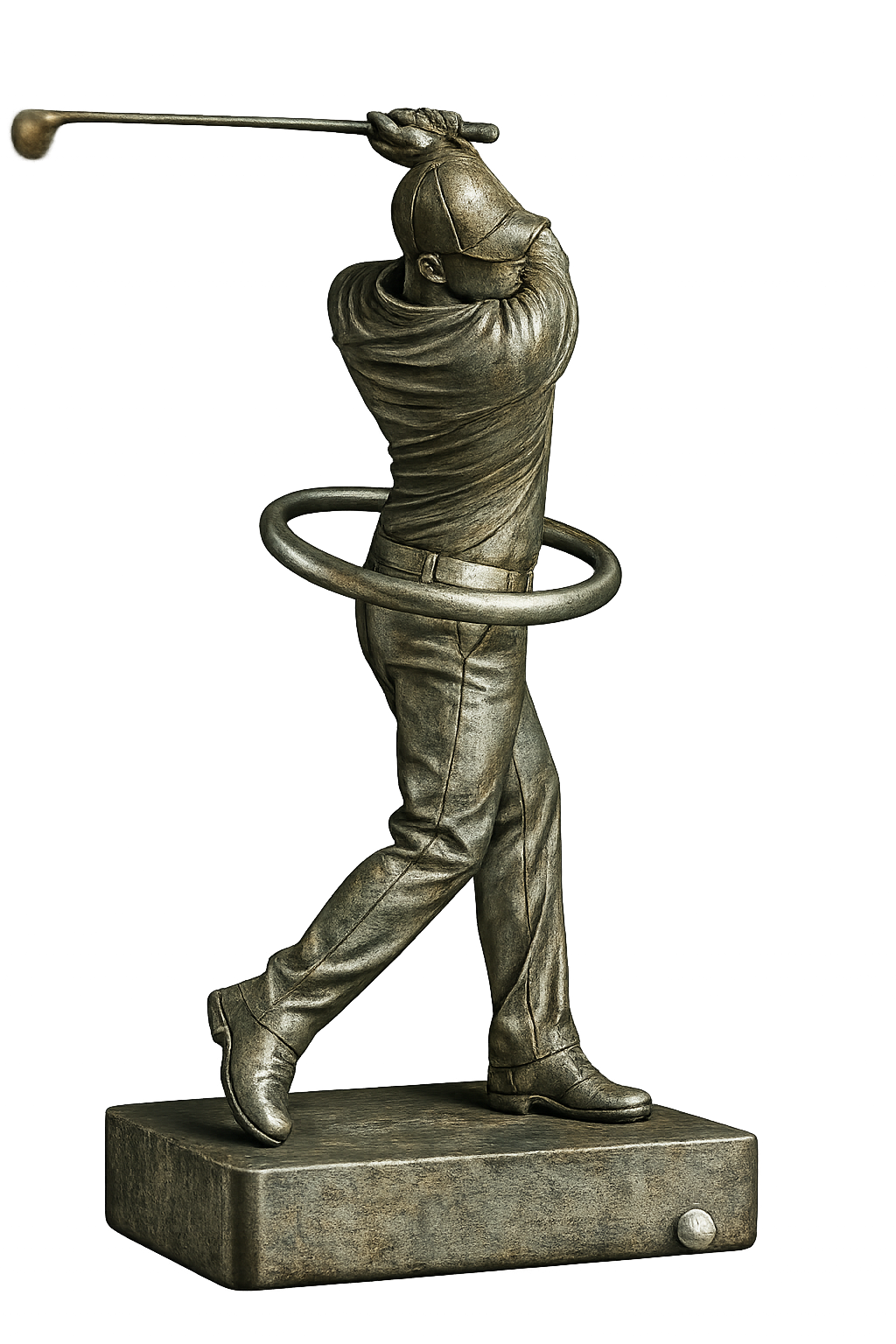
The Strong
Proper Core Activation to Protect Your Spine
|
 16
16
|
The Power Shield
Keep Your Structure Strong While Generating Maximum Power
|
“You can’t fire a cannon from a canoe.”
CHAPTER 14
THE WEAK
When Stability Breaks
Weakness in the golf swing rarely begins in the arms or legs. It begins in the middle when the core stops holding the spine steady and the body is forced to improvise. Once stability breaks, the hips slide, the chest lifts, the arms chase the club, and the back absorbs forces it cannot manage. This chapter reveals how instability sneaks into your swing, how it damages both performance and spine health, and how to rebuild the foundation so the body can move with confidence instead of fear.
I. THE AESTHETIC FIX
When you try to fix a chicken wing or a wrist flip without addressing the torso, you are fighting a losing battle. Your body has created those bad habits for a reason. They are survival mechanisms. If your torso is unstable, your brain forces your arms to seize up to maintain some semblance of control.
The Bounce Back Effect: No matter how many drills you do for your arms, the bad habit will definitely bounce back. You cannot override the body's need for stability. These symptom forced fixes only tighten the very structures, the wrists, hands, and elbows, that need to be loose and explosive.
The Real Unlock: To release the power in your limbs, you must first stabilize the core. Without a stable torso, the arms will always default to tension and compensation.
II. THE SOURCE OF COLLAPSE: THE CLOSED SYSTEM
A body that is closed cannot swing. This closure happens at the torso level and creates a chain reaction of weakness.
The Bellied Out Core: When the core pushes outward, known as The Slack, it creates a soft middle. This automatically closes the joints in the arms and legs, forcing them to become stiff and rigid to compensate for the wobbling spine.
The Chest Collapse: When the chest hunches forward, the shoulder sockets lock. This restricts the arms, forcing them to chase the club and wing out because there is no room to move.
III. THE SOLUTION: CALIBRATE THE TORSO
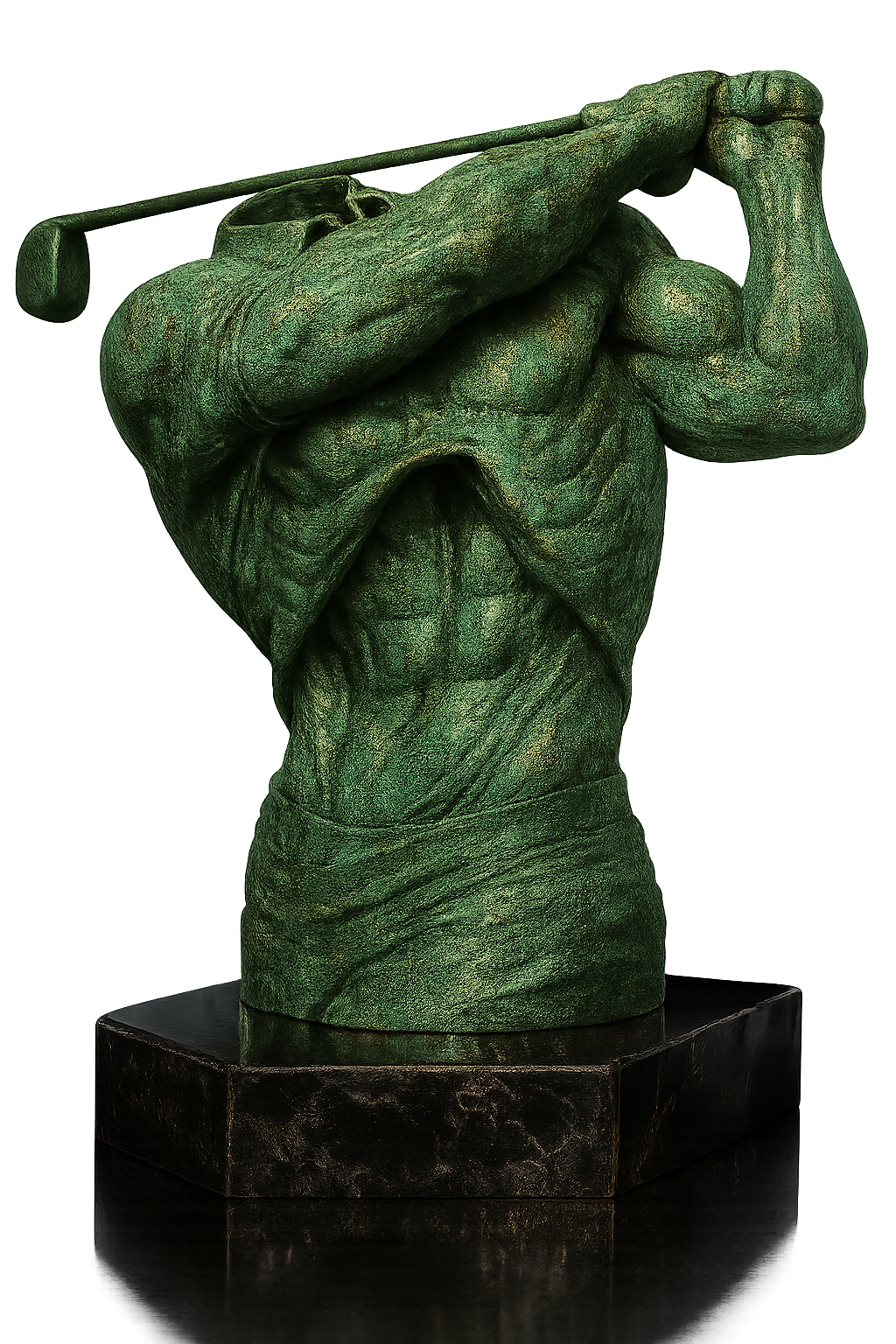
To open the joints in sequence, you must move from a closed system to an open one. This requires one simple, synchronized move: Core In, Chest Out.
Core In: By pulling the Core In, you engage the Internal Shield. This pulls the navel toward the spine, removes the slack, and creates a solid pillar for rotation.
Chest Out: By pushing the Chest Out, you retract the shoulder blades and open the shoulder sockets. This opening flows down the arms, allowing the elbows, wrists, and hands to finally relax and move with speed instead of tension.
IV. THE ENGINE ROOM: SOURCE VS. SYMPTOM
Stop fixing the symptom. Calibrate the torso to fix the source.
V. Every Champ Use This Muscle
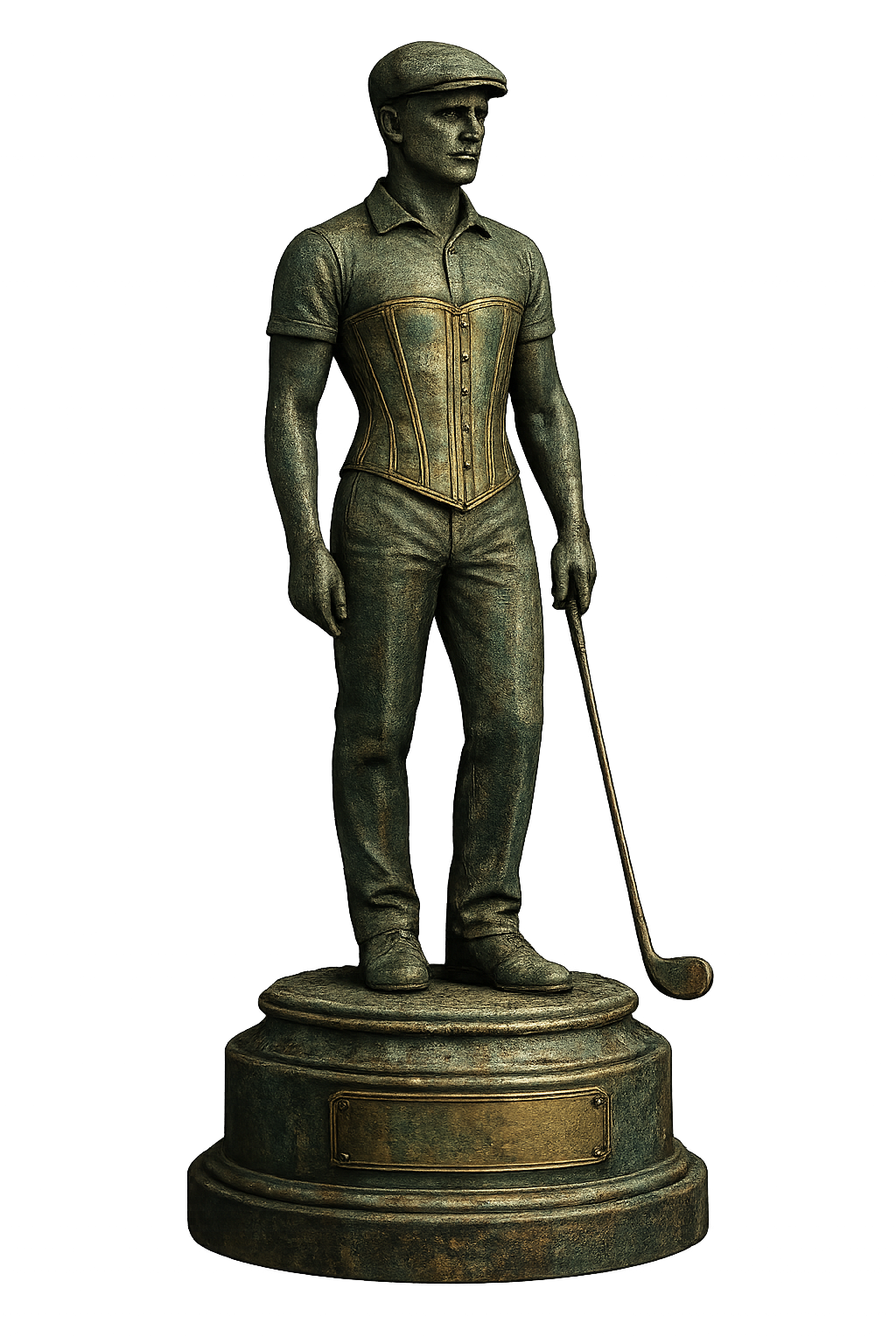
The Tranversus abdominis muscle builds a safer player. It has a magic effect on mechanic fundamentals. Think like you are wearing a "Victorian Corset." To understand how the torso fix works, imagine your core is secured within a firm, supportive corset. If your core is soft and your chest is collapsed, your hips will slide sideways as you turn, causing you to sway. This sway is the ultimate sign of weakness because your weight moves horizontally instead of rotationally.
When you engage the "Corset" by pulling your core in and pushing your chest out, you create a steel axis right down the center of your body. Instead of sliding, you now rotate perfectly within that tightened frame. Your right hip moves back and your left hip moves forward while your center remains locked in place. This is the difference between spinning with the precision of a top versus sliding like a swaying tree.
VI. OPEN YOUR KINETIC CHAIN
Once the torso is calibrated, the joints in your arms and legs finally have permission to open. You no longer have to force your elbows to stay in or your wrists to stay flat. Because the source is stable, the limbs can finally be free.
The result is Total Command. You stop fighting your own anatomy and start moving on a stabilized axis. You have moved from a Sand Foundation to a repeatable powerhouse where the body moves with confidence instead of fear.
⚖️ The Judgment on the Weak
The Evidence: The “Rotation Trap” and the “Sleeping Commander” were found guilty of negligence. The “Quick Fixes” proved that stability can be regained instantly through awareness.
The Sentence: You are sentenced to listen to your body’s “Pinch” and “Ache.” The “Wet Noodle” spine and the “Dancing Feet” are hereby evicted.
The Ruling: Moving as “One Piece” is not a suggestion; it is your insurance policy. By waking up the Commander and honoring the tracks of your tilt, you have moved from the vulnerability of “The Weak” to the protection of The Power Shield.
CASE CLOSED.
🔗 Research
- Horan et al.: Hip mobility restrictions increase lumbar stress and reduce swing efficiency; early evaluation prevents compensatory movement.
- Sells et al.: Initiating swing from the hips improves timing, reduces hand takeover, and increases clubhead speed.
- Sauret et al.: Imbalances in pelvis and trunk rotation contribute to low back pain; early correction prevents long-term structural damage.
- Kwon et al.: Safe ranges of pelvic tilt and controlled rotation correlate with efficient energy transfer and centered strikes.
- Han et al.: Consistent pelvic tilt angles throughout swing maximize rotational efficiency and reduce lumbar stress.
- Quinn et al.: Progressive core training improves trunk activation, neuromuscular control, and movement quality; weak core disrupts force transfer.
- Olivier et al.: Strong core stabilizes the pelvis and trunk, allowing energy to flow efficiently through the kinetic chain, enhancing swing power and reducing compensations.
- McGill et al.: A well-engaged core ensures coordinated movement from lower to upper body, preventing energy leaks and preserving swing consistency.
“Stop building a faster engine for a chassis made of glass.”
CHAPTER 15
THE STRONG
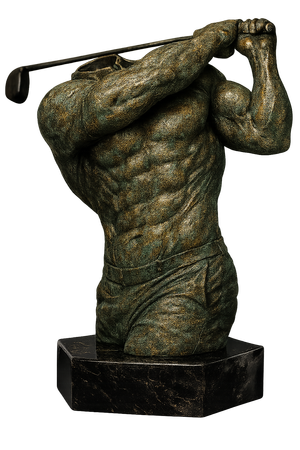
The Core In Control
A strong golfer is not the one who lifts the most weight, but the one whose core holds the line when the swing tries to pull the body apart. When the core stays in control, the spine remains protected, the hips rotate freely, and the arms deliver the club without strain. When the core loses command, the back absorbs forces it was never designed to handle. This chapter shows you how true strength begins in the middle, and why the safest swing is also the most powerful.
I. A STRONG CORE CONTROLS
Strength is not force. Strength is stability under pressure. A strong golfer is not the one who lifts the most weight, but the one whose core holds the line when the swing tries to pull the body apart. When the core stays in control, the spine remains protected, the hips rotate freely, and the arms deliver the club without strain.
When the core loses command, the back absorbs forces it was never designed to handle. True strength begins in the middle, and the safest swing is also the most powerful.
II. THE CLOSED LOOP SYSTEM
Power begins in the center. When the core braces inward, it synchronizes the entire chain. The hips hinge correctly, the spine steadies, and the legs develop a stable rhythm. This creates a Closed Loop System where energy is contained, directed, and released with precision.
In this system, no power is wasted. Every segment contributes to the momentum instead of leaking it, and the unified movement shields the joints from excessive pull.
- Total teamwork across the chain.
- Power multiplication instead of leakage.
- Joint protection through unified movement.
III. THE ENGINE ROOM: LOWER BODY RECRUITMENT
The lower body is the launchpad for distance. These units gather power from the ground and send it upward. When they are responsive, the core has a stable platform to operate from.
IV. THE DELIVERY TEAM: UPPER BODY PRECISION
The upper group does not create power; it delivers it. Once the lower body sends energy upward, these joints act as a coordinated lever system to strike with precision. Their job is to stay synced to the core so the release is clean, stable, and repeatable.
⚖️ The Judgment on The Strong
The Evidence: True strength was found to be Stability Under Pressure, not brute force. The “Closed Loop System” proved that when the Commander is awake, energy is recycled and multiplied.
The Sentence: The “Arm‑Led” struggle is hereby abolished. You are sentenced to rely on the Internal Shield and the Ground‑Up Launchpad.
The Ruling: By choosing Core Control, you have unlocked a “Beast‑Mode” performance that is as safe as it is explosive. The Safety Lock is off. The whip is ready to crack.
CASE CLOSED.
GLOBAL INJURY STATISTICS: THE PHYSICAL TOLL OF CORE AND GLUTEAL FAILURE
In the biomechanics of golf, the spine is never meant to be the primary engine. It is a conduit for power. However, when a golfer suffers from Gluteal Amnesia, a term popularized by spine expert Dr. Stuart McGill, or a dormant core, the spine is forced to transform from a stabilizer into a prime mover. This is a role it is anatomically unfit to perform.
THE STATISTICS OF SPINAL STRESS
• THE COMPRESSION REALITY: Research published in Sports Health indicates that the lumbar spine of a golfer can experience compressive loads up to 8 times body weight. Without a braced core to distribute this force, the intervertebral discs absorb the entirety of the impact.
• THE "CRUNCH FACTOR": This clinical term describes the lethal combination of lateral side bending and high-speed rotation. When the glutes fail to rotate the pelvis, the lower back "crunches" to compensate. This leads to the 15% to 37% injury rate reported in epidemiological studies.
• TECHNICAL FAILURE: Over 53% of golf injuries are caused by swing faults. Specifically, Early Extension, where the hips move toward the ball, is almost always caused by an inability to engage the glutes. This leads to immediate lower back strain.
THE HEAD TO FOOT CASCADE OF KINETIC FAILURE
• CERVICAL (NECK): A weak core causes the Upper Cross posture. The neck over-stabilizes to compensate for a shaky torso, resulting in facet joint irritation and chronic strain.
• SHOULDERS: Without core rotation, the golfer arms the club. This causes rotator cuff impingement because the shoulder is forced to generate torque rather than just directing it.
• THORACIC (MID BACK): Restricted hip mobility from weak glutes forces the mid back to over-rotate to find range. This leads to rib stress fractures and muscular spasms.
• LUMBAR (LOWER BACK): This is ground zero for injuries. Inactive glutes lead to S-Posture, putting the spine in a pre-stressed state before the swing begins. The result is often Spondylolysis or disc herniation.
• THE SACROILIAC JOINT: Without the gluteus maximus providing stability, the SI joint becomes hypermobile. This causes sharp, radiating pain during the transition from backswing to downswing.
• HIPS: Gluteal failure forces the hip flexors to work overtime, leading to labral tears as the femur slams into the socket without muscular deceleration.
• KNEES: Without gluteal support to control rotation, the lead knee often collapses inward. This puts extreme shear force on the meniscus and ACL.
• ANKLE AND FOOT: Poor core control leads to improper weight transfer and spinning out, which can result in plantar fasciitis and lateral ligament sprains.
WHY THE GLUTES AND CORE ARE BODYGUARDS
The glutes are the protectors of the lower back. According to the Journal of Exercise Rehabilitation, there is a direct correlation between decreased gluteal strength and chronic lower back pain in golfers. When the glutes and core quit, the spine is left to fend for itself against the most violent forces in sports.
“Stop steering the train; just lay the tracks with your core and let the swing slide.”
CHAPTER 16
THE POWER SHIELD
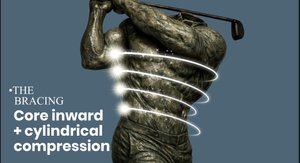
One Piece, One Power
Many golfers misunderstand where distance comes from. They think hitting the ball far requires frantic effort or pure physical struggle. But true power doesn't come from how hard you try; it comes from how well you hold your structure. When you maintain a strong, linked chain from the ground to the grip, your body becomes a shield of coiled energy. This chapter integrates the two critical halves of your power chain: The Engine Room and The Delivery Team. When these two units fire in sequence, you stop hitting at the ball with your arms and start swinging through it with your entire mass. This is the secret to a heavy, compressed strike.
I. THE MECHANISM OF THE PROBLEM
Before you can build the Power Shield, you must understand why most golfers lose stability. The body can move in many directions, but the golf swing requires everything to work together as one unit. When one part moves without the others, the system breaks.
Most golfers let their arms start the swing, then their chest tries to catch up, and their hips react late. Each part moves on its own timeline. This creates gaps where energy leaks out and exposes the spine to forces it cannot safely handle.
II. THE SOLID FRAME VS. THE WOBBLY BODY
A solid frame is like a strong machine where all parts are bolted together. In the body, your core is that bolting system. Most golfers have a "Wobbly Body" because their arms move without their chest, and their chest moves without their hips.
When the core is loose, the bolt is missing. The arms drift, the chest wobbles, and the hips slide. By tightening the core, you create a solid frame where the shoulders, chest, and arms move together as one unit.
III. THE GOAL: TOTAL UNITY
The goal is One Piece Command. Your shoulders, core, and hands must stay connected throughout the entire motion. You are no longer a collection of separate pieces; you are one strong unit turning around a steady center.
This removes timing mistakes, stops shanks or blocks, and protects your back from the injury caused by independent, disconnected movements.
IV. REQUIREMENT: THE 360 DEGREE SEAL
To keep the Power Shield alive, your core must stay gently tightened from the start of the swing to the finish. If you relax it, the seal breaks and everything collapses.
Think of it like keeping air pressure inside a tire. If the pressure drops, the tire fails. You must stay braced and rotate the whole pressurized body together to ensure the "bolt" stays in place and the structure remains upright.
V. LOWER GROUP: THE FOUNDATION THAT HOLDS EVERYTHING UP
Your lower body forms the base of the Power Shield. If anything shifts or collapses, the whole system becomes unstable.
UPPER GROUP: THE PARTS THAT BREAK THE SYSTEM
The upper body ruins the Power Shield when it moves on its own instead of staying connected to the core.
VI. THE CORE FIX: THE ONE UNIT DRILL
To finish your Power Shield, you must feel your body working as one piece through these four checkpoints:
Chest Arm Lock:
Lightly keep your upper arms touching your ribs to maintain physical connection.
The Cinch:
Tighten your core until your body feels like one solid, pressurized cylinder.
The Unit Turn:
Turn your whole body together. If your arms lift away from your ribs, the connection is broken.
The Heavy Strike:
Let the weight of your whole body deliver the hit. Power comes from the unit, not from fast hands.
⚓ The Verdict: The Power Shield
The Evidence: Disconnection was found guilty of being the primary cause of shanks and spinal stress. The Power Shield has proven that moving as One Piece is the only way to protect the spine while maximizing output.
The Sentence: Independent arm‑swinging is hereby exiled. You are sentenced to move as an Iron Monolith from address to finish.
The Ruling: One Piece equals One Power. By sealing the 360‑degree brace, you have moved from a collection of parts to a Unified Strike Force.
CASE CLOSED.
🔗 Research
Verified research showing how insufficient core stability disrupts coordinated movement, reduces force transfer, increases compensatory stress, and is linked with injury risk in golf and athletic activities.
- Horan et al.: Trunk muscle activation patterns, hip strength, and pelvis/trunk rotation are associated with low back stress in golf; poor trunk stability contributes to harmful loading and compensations.
- Tinmark et al.: Limited hip mobility and weak trunk control lead to altered lumbopelvic mechanics, increased lumbar stress, and less efficient swing energy transfer.
- Olivier et al.: Systematic review shows that core stability enhances force production and transfer while reducing energy leaks during movement.
- McGill et al.: Research outlines how a strong core enables force transfer from lower extremities through the torso to the terminal segment; deficits disrupt energy flow and can reduce performance.
- Quinn et al.: Progressive core training improves trunk muscle activation, balance, and neuromuscular control deficits in these areas are linked with compromised movement quality and stability.