PART 4
THE POWER WITHIN

▸▸▸ ENTERING PART 4
You have built stability. You have learned how to hold your ground, how to stop wobbling under pressure, and how to keep your structure steady when the swing begins to load. Part 3 gave you the anchor. Now you step into the phase where power is created from the inside.
This is where the engine wakes up.
Internal Fuel is not about strength. It is not about effort. It is about choosing the right pattern that lets the body create power without strain.
Every golfer has a power source. Some rely on the back. Some rely on the core. Most never realize which one they are using, and even fewer know how to choose the one that protects their spine and sharpens their strike.
Part 4 reveals that choice.
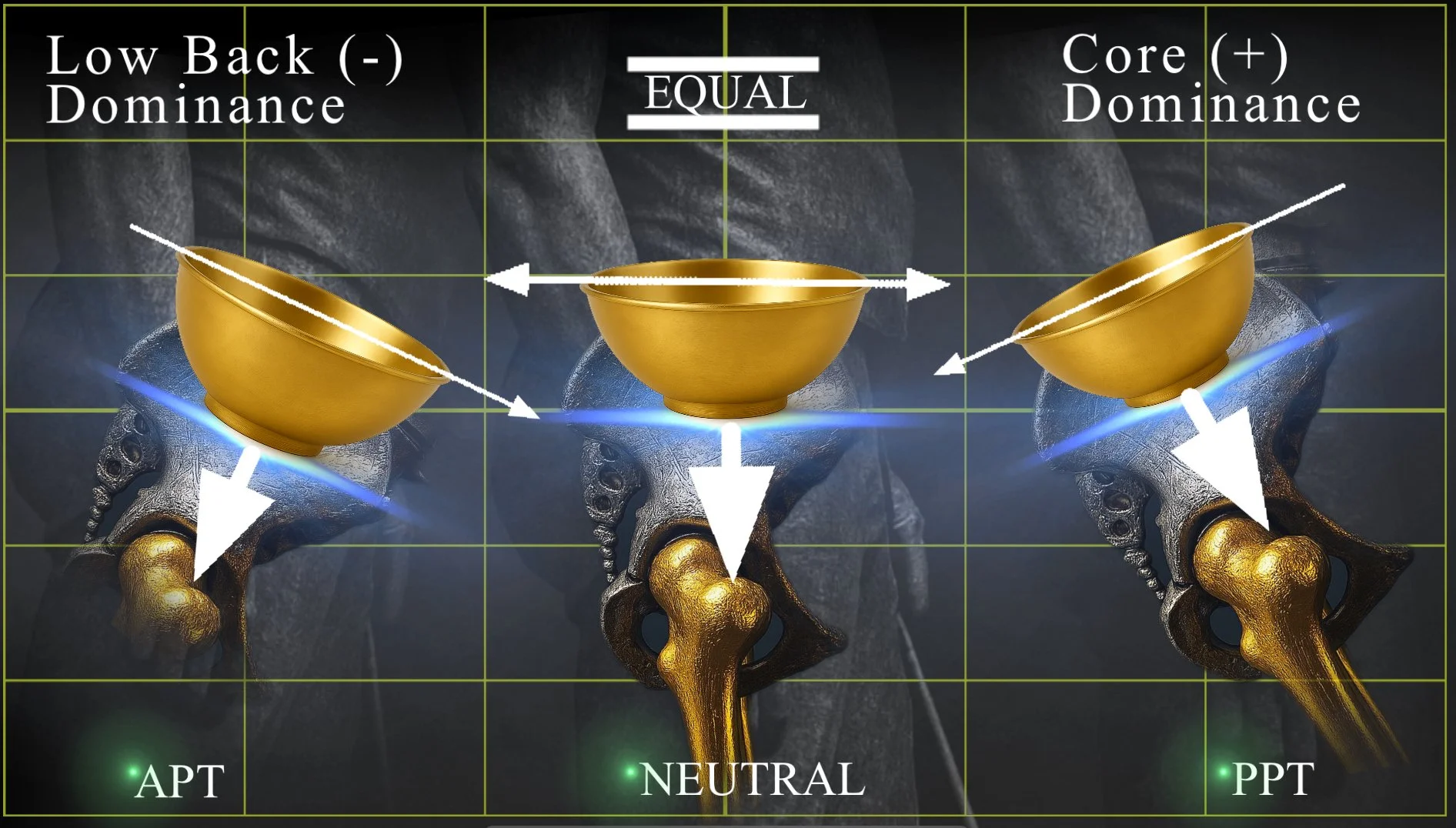
This is where you learn how pelvic tilt shapes muscle activation, how the body selects its internal engine, and how the right pattern turns chaos into rhythm. When you choose the wrong pattern, the swing feels unstable, the back tightens, and power leaks. When you choose the right one, the body feels organized, the strike feels centered, and the swing finally makes sense.
▸▸ STATUS
If you can feel your base holding steady and your posture no longer collapses when you breathe in, you are ready for this phase. If your balance still drifts or your hips feel uncertain under load, stay with Part 3 until your foundation stops searching for stability.
Part 4 requires internal clarity. You are choosing your power source. Nothing less.
In Chapter 8, you discover why the core prefers simplicity, why too many cues weaken activation, and how tilt becomes the switch that organizes the entire chain. You learn how to select the pattern that fuels your swing, protects your spine, and delivers power without strain.
This is where the engine becomes yours. This is where Internal Fuel begins.
You may now proceed to Chapter 8.
"A powerful and beautiful swing has power source made of bedrock of stability."
CHAPTER 8
PELVIC POWER LOCK
Choosing Muscle Activation
Every golfer has a default power source. Some pull from the arms, some from the legs, and some from the hips. But the most consistent and injury resistant players pull from the core. When the core becomes the primary engine, the swing becomes smoother, more predictable, and far easier to repeat under pressure. This chapter shows you how to choose the right muscle activation pattern so your body produces power the way it was designed to, not the way habit has forced it to.
I. SAY: "Core In"
The greatest threat to your golf game is Information Overload. If your mind is fed too many technical thoughts, your body chokes on the complexity and your rhythm evaporates. Think of instructions as apples. A few apples of knowledge are enough to fuel a great swing. Try to eat the whole basket and you will not be able to move. To achieve a state of flow, you must limit your inputs to these simple cues:
The Ignition: Simply say Core In.
The Maintenance: Maintain that inward pressure from the start of the swing until the ball is gone.
The Follow Through: After the hit, give yourself one final reminder: Do not let go.
II. THE PELVIS
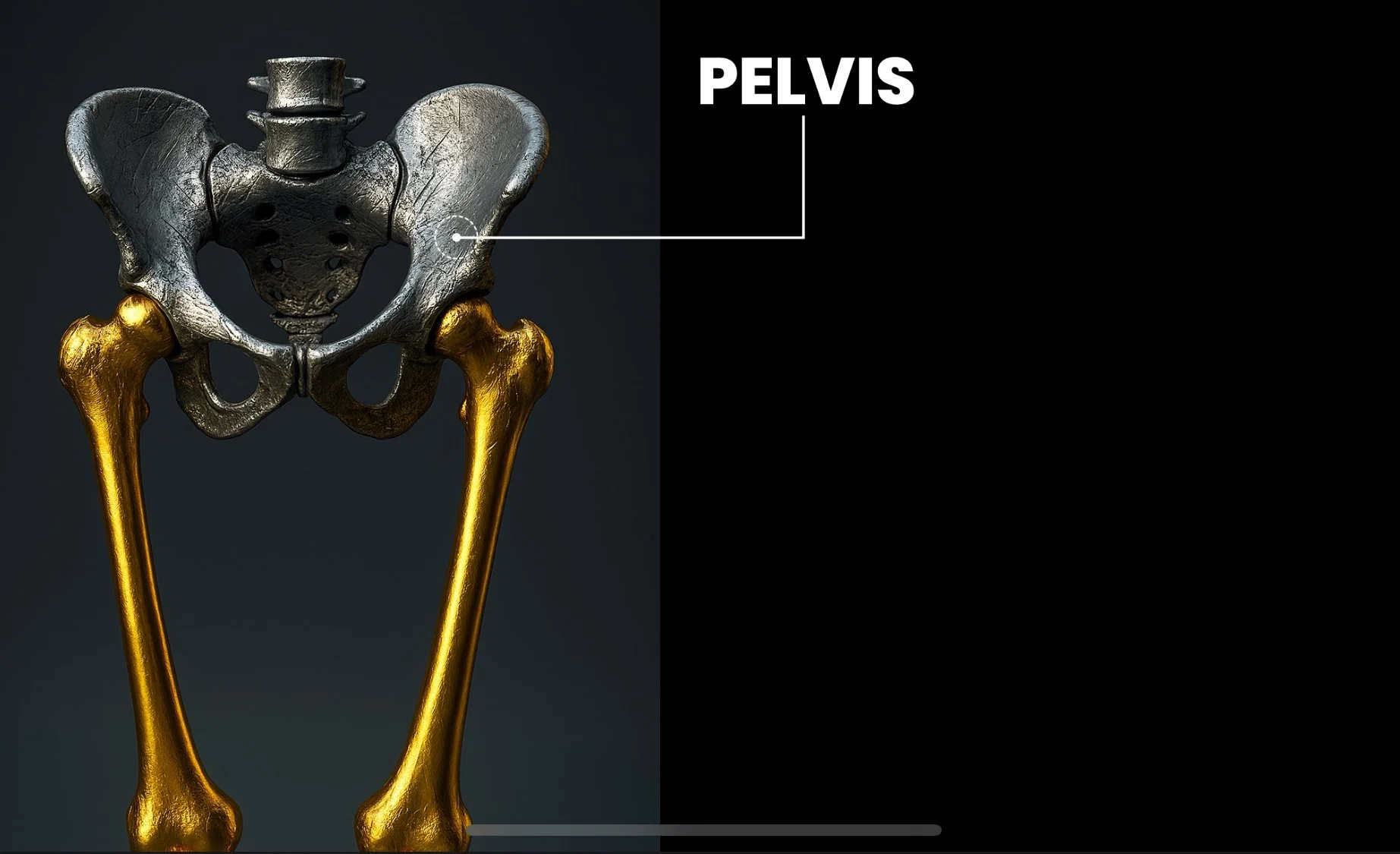
Viewing the body as a high performance machine, it becomes clear that the pelvis is the steering wheel of the spine. Biomechanical research by Hosea et al. (1990) shows the spine can absorb forces approaching 1,600 pounds (720 kg) at impact. The way the pelvis is tilted determines whether this energy is transmitted efficiently into the ball or absorbed as structural stress by the vertebrae.
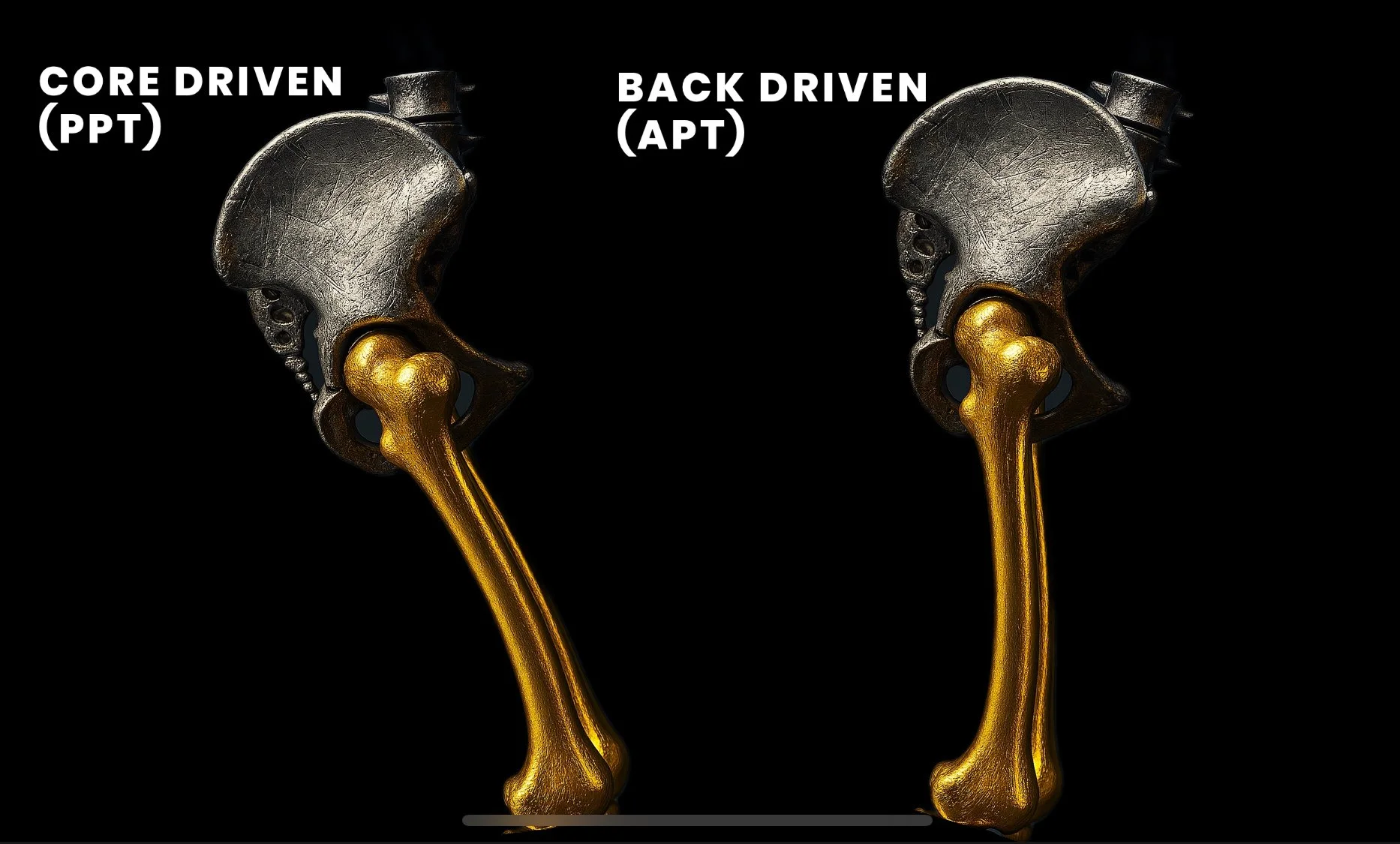
III. TACTICAL BALANCE
While the Posterior Tilt is your primary shield, the system must remain flexible. Rigidity is the enemy of rhythm.
The Damage Report
We look for over bracing. If you are squeezing so hard that you cannot breathe or rotate, you have created a secondary structural blockage.
When APT Helps: If you feel too locked up or stiff to move, a slight forward tip of the pelvis can restore your mobility and free up your hips.
When PPT Is Too Much: PPT works best as a firm anchor, not a death grip. Loosen the tuck slightly to let the rotation flow.
IV. IGNITION SWITCH
Before you step onto the first tee, you must calibrate your internal fuel. Use these high contrast Lab Drills to feel the switch:
The Wall Anchor (Feeling PPT): Stand with your back against a wall with feet six inches away. Try to flatten the small of your back against the wall by tucking your pelvis. You will feel your lower abs zip up and your glutes engage. This is the Power Lock.
The Chair Pivot: Sit on the edge of a firm chair with hands on your shoulders. Rotate your torso while keeping your pelvis heavy and tucked. The tightness in your obliques is rotational torque being stored. If you let your back arch, that tightness disappears.
V. GOLF SWING CALIBRATION
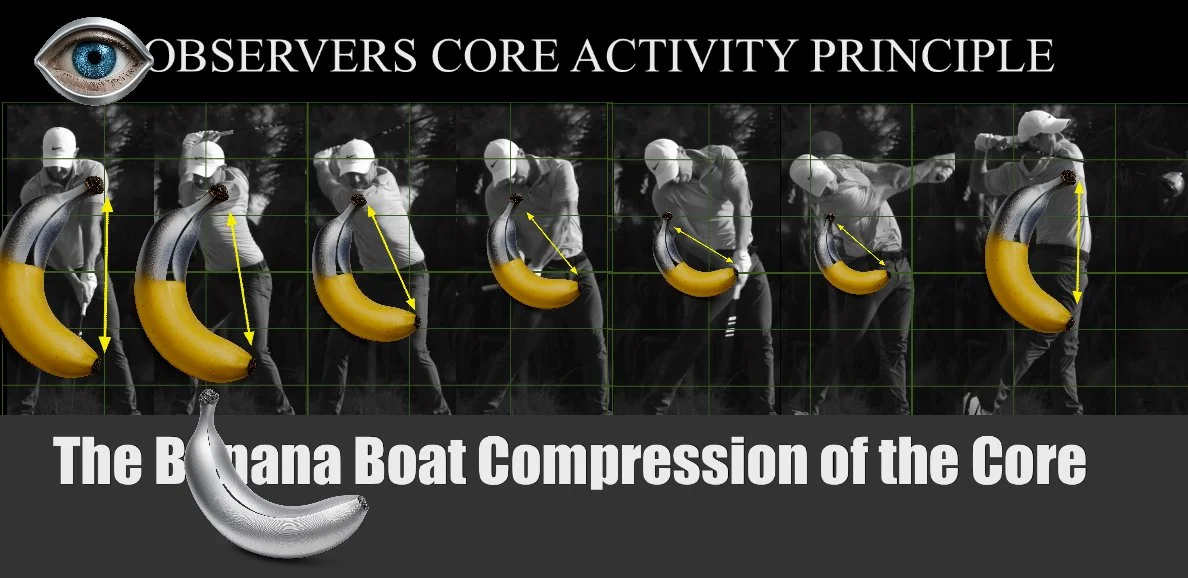
The Banana Boat Principle is a phase by phase calibration ensures your posture and tilt work together to preserve both performance and structural integrity by managing the "curvature" of your core.
Address: When bracing the banana; tucking the pelvis braces the system and stabilizes the foundation. Think of this as aligning the banana vertically; an arched back leaves the core passive and the banana "broken," while a tucked pelvis creates the initial tension.
Backswing: Anchoring the Curve; the anterior tilt causes the spine to arch and the club to lift off plane. Utilizing posterior tilt anchors the rotation, keeping the spine long. Here, the banana remains straight but axially loaded, preventing the "banana" from snapping under the weight of the lift.
Downswing: The Compression Snap; if the pelvis stays tipped forward, wrists tighten and the spine carries the torque. When the core leads, the banana begins its inward compression. The pelvis re-centers, shortening the core into that tight "C" shape, allowing energy to flow cleanly through the center of the banana.
Impact: Peak Banana Compression; at this moment, the banana is at its maximum "C" curve. A proper core brace ensures power transfers efficiently into the ball, using that compressed shape to protect the joints from the 1,600-pound impact force.
Follow Through: Releasing the Tension; finish with a body that can breathe. Let the pelvis re-center and the banana decompress. By allowing the core to "un-curve," the spine decompresses so you can finish in perfect, upright balance.
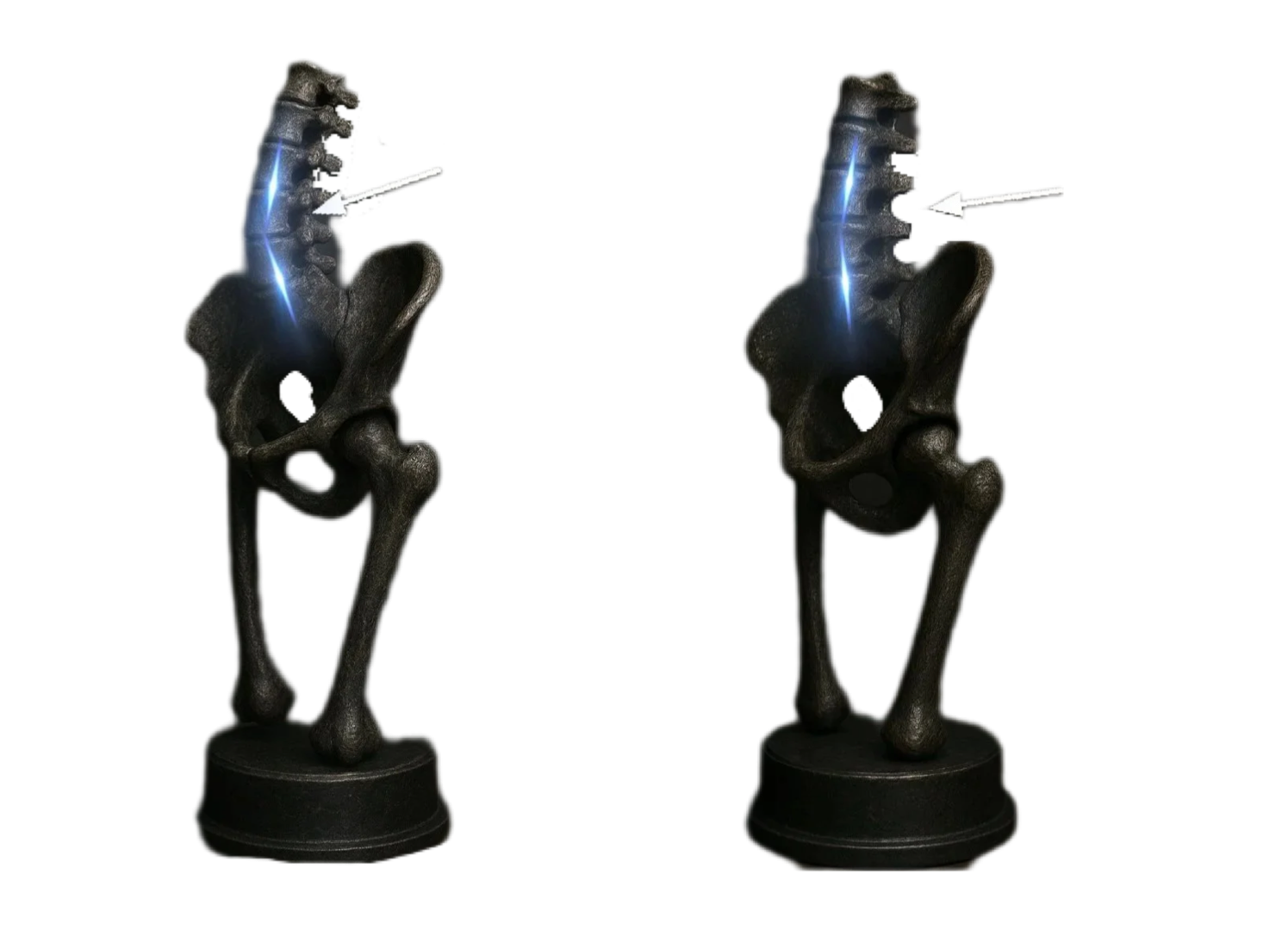
VI. CHOOSE YOUR SWING IDENTITY
Pick the pattern that fits your build and rhythm:
The Speed Frame (Core Dominant): Relies on high levels of PPT control to maintain the Stability Anchor at high speeds.
The Power Frame (Back Dominant): Often benefits from a tactical APT strategy to support the rotation of a larger physical frame.
⚖️ The Verdict
The Evidence: The investigation into muscle activation reveals that overthinking is the primary Saboteur of the kinetic chain. The mind cannot process a basket of apples while the body is trying to manage 720kg of swing force.
The Sentence: You are sentenced to Simplicity over Complexity. You are hereby forbidden from taking more than one apple of knowledge to the tee box. The Late Scramble and the Wet Noodle Core are evicted from your swing.
The Ruling: Comfort over conformity is the rule of the athlete. Feed the core only the apples it needs to stay ignited. Brace for the strike, but exhale through the finish. Take the one apple that matters: Core In. Everything else is just noise.
CASE CLOSED.
🔗 Chapter 8 Research: Core Dominant Power
- Gluck, Bendo, and Spivak: Specific research on the lumbar spine in golf, demonstrating how precise core muscle focus is a necessary component for force transfer and spinal protection.
- Hume, Keogh, and Reid: Direct-to-abstract link for the study identifying coordinated trunk and pelvic rotational speeds as the primary driver of clubhead velocity in skilled golfers.
- Neal et al. (Referred as Hume/Keogh/Reid 2005): Foundational biomechanics research on maximizing distance through the summation of force principle, starting with proximal hip and trunk acceleration.
- Myers, Lephart, and Tsai: Specific study on how an 8-week golf-specific exercise program improves torso rotational velocity, carry distance, and overall driving power.
- Kwon et al.: Landing page for the peer-reviewed analysis of trunk and pelvic rotation timing, proving that efficient swings rely on early proximal engagement.
- Sorbie et al.: Direct link to the 2020 review on biomechanical risk factors, confirming that core-driven patterns are essential for both performance and LBP prevention.