


PART 2
THE PROTECTOR

▸▸▸ ENTERING PART 2
You have completed the Genesis. You now understand where power begins. You have seen how the Core awakens, how pelvic patterns shape your motion, and how the true source of the swing reveals itself when you finally look beneath the surface.
But knowing the origin of power is only the beginning. Before you build speed, before you chase compression, before you ignite the chain reaction that sends the ball into orbit, you must confirm that your structure can hold the load. Every golfer wants more distance. Few ever ask whether their body is ready for it.
Part 2 is the checkpoint. The truth teller. The point where the body reveals what the mind has been ignoring.
▸▸ STATUS
If you feel the Core awakening with clarity and your setup no longer collapses under tension, you are ready to move forward. If your posture still drifts or your back tightens under pressure, stay here and refine the basics. The next phase demands honesty from your structure.
In Chapter 4, you face the 19th Hole, not as a drink or a celebration, but as the quiet pause where your back tells the truth about your swing. In Chapter 5, you learn how structure protects power, how the hips and back reinforce the engine you awakened in Part 1.
You are no longer learning what the Core is. You are learning whether you can hold it. If Part 1 lit the spark, Part 2 protects the flame.
You may now proceed to Chapter 4.
|
PART 2: THE PROTECTOR
When the Back Is Put to the Test |
|
| Chapter | Title |
 4
4
|
The Back Does Not Lie
The Pain Is Your Alarm
|
 5
5
|
Structural Advantage
Strength and Stability for Powerful Rotation
|
"Your club hides the error, but your back writes the confession; fix the motion before the spine pays for the crime."
CHAPTER 4
THE BACK DOES NOT LIE
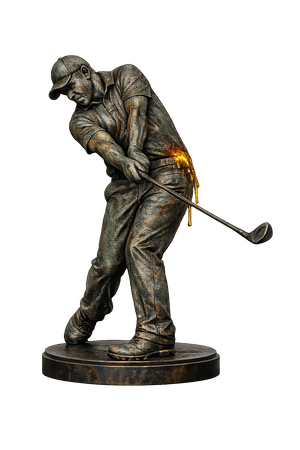
The Truth About Your Back
The back is the scoreboard of your swing. Every imbalance, every restriction, and every forced motion leaves a signature in the spine. When golfers feel tightness, fatigue, or sharp discomfort, the back is often revealing the deeper mechanical story. This chapter helps you read those signals so you can understand how your body is moving and where your swing is quietly losing stability and power.
I. THE DAMAGE REPORT
Stop being a victim of mystery back pain.
Pain is a Damage Report. It is the signal that your foundation has folded under the high-velocity pressure of the swing. When your center is not locked, your spine is forced to catch a load it was never built to carry.
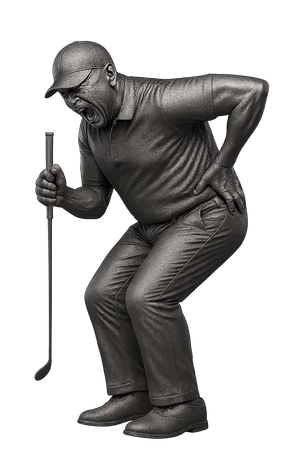
You must read these warning signals before a small ache becomes a permanent injury. The goal is to move from surviving the swing to owning the move. By stopping this collapse, you protect your spine and reclaim the power you have been leaking into your joints.
II. OUCH!
• The Collapse: Happens when your core stops acting like a solid wall and starts acting like a wet noodle.
• The Danger to Your Body: In a powerful swing, the body is under massive pressure. If the center is not locked, the structure folds and the weight lands directly on your spine. Instead of your muscles absorbing the speed, your vertebrae grind together. You are not just swinging a club; you are micro-fracturing your future. This leads to the stubborn, recurring pain that eventually ends a golfer's career.
• The Danger to Your Game: A collapsing body cannot maintain a steady path.
• The Power Leak: Energy that should go into the ball is wasted as your body shifts and wobbles just to stay upright.
• The Rescue Move: Because the base is folding, your hands have to flick at the last millisecond to save the shot. This explains why your good shots are a mystery and your bad shots are a disaster.
III. Neutral Pelvic Tilt
Your back does not lie. It is the ultimate truth-teller of your swing’s efficiency. If you finish a round with a nagging ache in the lumbar or a sharp pull in the mid-back, your abdominal core has already failed you. Pain is simply the sound of a leaking epicenter. When the core fails to maintain Inward Pressure, the spine is forced to move from a stabilizer to a prime mover. A role it was never engineered to play.
IV. IS YOUR BACK HAPPY OR HURTING?
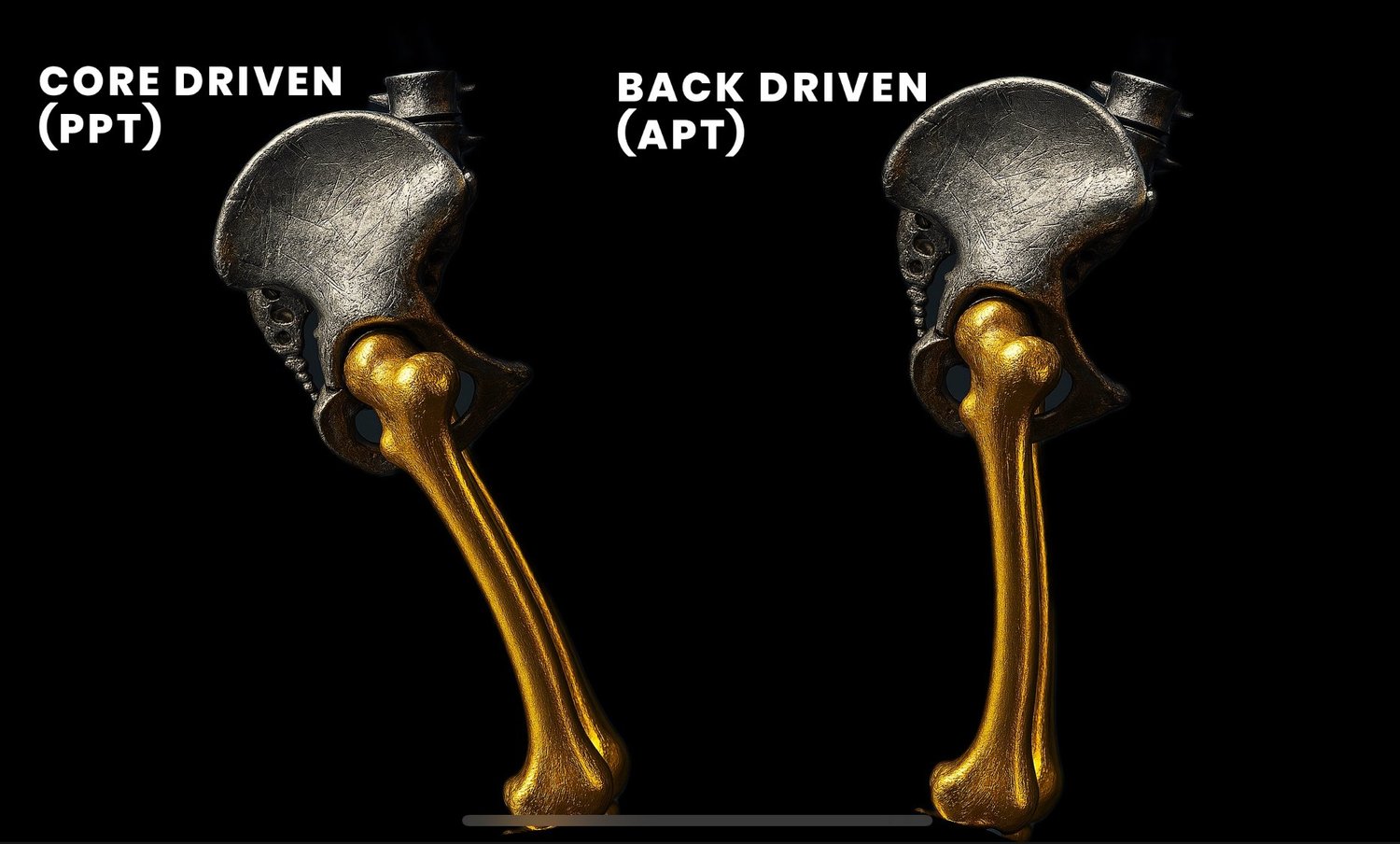
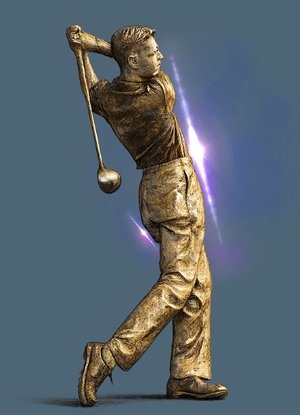
A happy back is not about stiffness. It is about the core and glutes firing together to stabilize the spine while generating rotational power.
V. THE CORE SHIELD PROTOCOL
• The Pre-Game Wakeup: Do not just swing a club. Wake up your hips and glutes so they can protect your spine.
• The Mid-Round Reset: If you feel a twinge, your center has drifted. Reset your posture and find your anchor.
• The Post-Game Release: Stretch the hips to let the wind-up pressure out of your lower back.
VI. THE BAD WHISPERS
• The Saboteur Muscle: Whispers lies that sound like advice: “Stick your chest out! Stand taller! Look athletic!”
• The Pelvic Flip: Your pelvis tips forward, losing its solid base.
• The Belly Pop: Your stomach pushes out and ribs flare, letting all your power leak.
• The Spine Fold: Lower back arches painfully, absorbing force meant for the ball.
• The Outcome: Golfers get sore, lose accuracy, and the internal anchor fails.
⚖️ The Verdict: The Saboteur at the Front Gate
The Evidence: The investigation into chronic back pain reveals that “bad luck” is actually a Damage Report. The evidence shows that the Saboteur at the front of your hips is a double agent. By whispering lies like “Stand taller” and “Look athletic,” he lures the body into the Pelvic Flip and the Spine Fold, turning your internal anchor into a wet noodle that cannot support the weight of the swing.
CASE CLOSED.
🔗 Chapter 4 Research: Spinal Mechanics
Verified, peer-reviewed research showing how spinal mobility and segmental control reveal hidden power leaks.
- Dr. Stuart McGill (2005): Research on "proximal stiffness" confirming that segmental spine control is the prerequisite for high-velocity rotation.
- Okada et al. (2013): Data showing that thoracic and lumbar mobility are direct predictors of kinetic energy transfer to the clubhead.
- Choi & Lee (2017): Study on core engagement patterns and their role in preventing compensatory "early extension" movements.
- Hume et al. (2011): Biomechanical evidence that spinal restrictions force an inefficient "hands-only" takeover in the swing sequence.
"Lock the glutes and abdominal core to secure the pelvis and let the physics save your back."
CHAPTER 5
STRUCTURAL ADVANTAGE

Reinforcing Hip and Back
The hips and back form the structural engine of your golf swing. In this machine, the hips provide the torque, but the back must provide the stability. When the hips are weak, the back is forced to compensate acting as an anchor it was never meant to be. When the back is unstable, the hips cannot rotate with confidence, causing the engine to "misfire." This chapter provides your Field Manual for reinforcement. You will learn to distinguish between a Protected Engine and a Leaking Engine, ensuring your body can support rotation, absorb force, and deliver power without structural strain.

I. THE BLUEPRINT: The Train and Its Switches
Your arms and shoulders are the railroad switch. They determine the track and guide the final direction. But your pelvis is the steam engine locomotive. Imagine standing in the conductor’s booth, frantically pulling the direction levers while the boiler is cold and the wheels are locked. You are making adjustments, but you aren't moving an inch.
This is the central struggle on the practice range. Most golfers manipulate their arms and shoulders (the switch) without ever building pressure in the engine. When your center is tucked and locked into a stable athletic posture, the locomotive finally engages. Without this connection, you are shoveling coal into an empty firebox working 100% harder for 50% less momentum down the tracks.
To gain a true structural advantage, you must stop steering the train and start igniting the engine.
II. THE TRACKS: Setting the Course (Setup and Alignment)
Before the locomotive can move, the tracks must be aligned. This is your address and setup. If the tracks point into the woods, the most powerful engine in the world will only deliver you deeper into the trees. To ensure your core is inward and your engine is primed, use these two station checks:
• The Psoas Reset: While in a lunge, squeeze your back glute as hard as you can. This forces the "saboteur" muscle in the front to lengthen while the engine (the glute) turns on.
• The Glute Anchor: Stand in a wide golf stance and push your feet into the ground like you are trying to slide the earth apart. This creates a spring-loaded hip ready to drive the rotation.
III. THE BACKSWING: Building Pressure in the Boiler
The backswing is the process of stoking the fire. As you rotate, your torso turns against a stable lower body, creating the X-Factor stretch. Think of this as the locomotive reversing into the station to hook up to heavy cargo. You are winding the internal gears of the engine.
• Power Storage: Your feet feel glued to the ground, coiling you like a high-tension spring.
• Smooth Motion: Your hips turn easily because your lower back is not jammed. If you only move your arms, you have unhooked the engine from the train. You must feel the resistance in your trail hip and core, allowing the steam pressure to reach its maximum PSI at the top.
IV. THE DOWNSWING: The Drive Wheels Engage
The kinematic sequence triggers: the heavy drive wheels of the locomotive must turn first. Power flows from the ground up: Pelvis → Torso → Arms → Club. Many golfers try to start the downswing with their hands (the switch). That is like trying to move a 200-ton train by pushing the levers. Instead, the locomotive must lurch forward first. As the massive drive wheels grip the tracks, they pull the rest of the train in a whip-like "pull." The clubhead reaches maximum velocity at impact, delivering the full weight of the locomotive into the ball.
II. THE TRACKS: Setting the Course (Setup and Alignment)
Before the locomotive can move, the tracks must be aligned. This is your address and setup. If the tracks point into the woods, the most powerful engine in the world will only deliver you deeper into the trees. To ensure your core is inward and your engine is primed, use these two station checks:
• The Psoas Reset: While in a lunge, squeeze your back glute as hard as you can. This forces the "saboteur" muscle in the front to lengthen while the engine (the glute) turns on.
• The Glute Anchor: Stand in a wide golf stance and push your feet into the ground like you are trying to slide the earth apart. This creates a spring-loaded hip ready to drive the rotation.
III. THE BACKSWING: Building Pressure in the Boiler
The backswing is the process of stoking the fire. As you rotate, your torso turns against a stable lower body, creating the X-Factor stretch. Think of this as the locomotive reversing into the station to hook up to heavy cargo. You are winding the internal gears of the engine.
• Power Storage: Your feet feel glued to the ground, coiling you like a high-tension spring.
• Smooth Motion: Your hips turn easily because your lower back is not jammed. If you only move your arms, you have unhooked the engine from the train. You must feel the resistance in your trail hip and core, allowing the steam pressure to reach its maximum PSI at the top.
IV. THE DOWNSWING: The Drive Wheels Engage
The kinematic sequence triggers: the heavy drive wheels of the locomotive must turn first. Power flows from the ground up: Pelvis → Torso → Arms → Club. Many golfers try to start the downswing with their hands (the switch). That is like trying to move a 200-ton train by pushing the levers. Instead, the locomotive must lurch forward first. As the massive drive wheels grip the tracks, they pull the rest of the train in a whip-like "pull." The clubhead reaches maximum velocity at impact, delivering the full weight of the locomotive into the ball.
V. EMERGENCY BRAKE
• Derailment: When a golfer loses their connection, they hit the emergency brake. This often manifests as early extension or "casting," where the boiler leaks pressure before the train even starts moving. If the locomotive (pelvis) stops or jumps the track, the switch (arms) has to take over completely, leading to a catastrophic loss of speed and a derailment of the shot. Keeping the boiler pressurized and the wheels on the track is the only way to avoid the shanks or slices that signal a total system failure.
• Impact Damage: The shock of impact runs directly into your vertebrae. Without the core and glutes acting as a muscle shield, you are choosing bone over muscle to stabilize the train. This puts the lower back at high risk as the structural steel of the locomotive begins to buckle under the pressure.
VI. FOLLOW-THROUGH: Momentum
• The Ball is Gone: The finish is the natural deceleration of the locomotive after the cargo has been delivered. Once the ball is gone, the steam has been spent and the momentum simply carries the train to its destination. If you try to stop the train abruptly, you risk jumping the tracks. A full, balanced finish indicates that the engine and the switches worked in perfect harmony. The locomotive should end its journey facing the target, fully uncoiled, with all the weight transferred to the lead side. This is the sign of an efficient trip. The momentum was used to move the train, not wasted on friction or internal struggle.
VII. THE STRUCTURAL TRAP
Before you can reinforce the system, you must identify exactly where the leaks are occurring. Most golfers fall into one of two traps that lead to a structural collapse. Use this table to diagnose the symptoms of your specific structural failure and apply the immediate fix to lock the engine back into place.
When you enter this trap, you are essentially locking your spine before you even move. The body, desperate for motion, responds by swaying sideways instead of coiling, forcing the epicenter to leak energy directly into your spinal discs rather than into the clubhead.
Fix: By tucking the tailbone and pulling the belly in, you decompress the vertebrae and reset the pelvis to a neutral, athletic state. This reopens the gears so the engine can finally rotate.
| B: THE OVER‑BRACED GOLFER (THE RIGIDITY TRAP) | |
| Biomechanical Failure | The spine’s natural curve is erased. |
| Result | The swing becomes a stiff, wooden movement. Rotation shrinks because the gears of the hips and spine are jammed against each other. |
| Symptom | Power leaks out before impact; the swing feels short and labored. |
In this trap, you have confused stability with stiffness. By erasing the natural curve of the spine through excessive, stagnant tension, you have jammed the engine. The swing feels labored and "wooden" because the muscles are too tight to allow the joints to slide.
VIII. THE FIELD MANUAL: Stop the System Collapse
Use this cheat sheet as your biological repair kit. Identify the problem you are feeling in the moment, apply the simple fix, and feel the immediate restoration of your structural integrity.
🔗 Chapter 5 Research: Hip & Pelvic Stability
Verified, peer-reviewed research on how hip stability and core reinforcement optimize force absorption and swing power.
- Dr. Stuart McGill: Evidence on how lumbar stabilization exercises create a "spared" spine while facilitating high-velocity hip rotation.
- Hodges & Richardson: Biomechanical proof that deep core activation (TrA) is the primary stabilizer of the pelvis during rapid limb movement.
- Escamilla et al.: Clinical analysis showing that gluteal and hip strength reduces torque on the lower back during the follow-through.
- Behm et al.: Study confirming that integrated core-to-hip stability is a key differentiator in professional-grade swing efficiency.
⚖️ The Verdict: Structural Advantage
The Evidence: Structural Advantage is the difference between a golfer who is surviving the round and an athlete who is dominating it. When your center is locked, the micro flinches that cause pushed putts and weak fades vanish. You now have the X‑Ray Vision to see the leaks. You have the Damage Report on why your back has been struggling. But a diagnosis is not a cure.
The Sentence: To permanently stop the system collapse and unlock the Massive Distance and Dead Aim Putting promised by the Codex, you must move to the next phase. The specific protocols to anchor your stability and the One Simple Move are waiting for you in the next section.
CASE CLOSED.