


WELCOME

The Golf Swing Ignition
The Secret Move for Massive Distance, Power, and Pin-Point Precision
A Fundamental Core Doctrine

Preface
Core Ignition Doctrine is not asking you to go hyper nosebleed memorizing Latin cues or choking on jargon. The real secret here is a gift of simplicity. You need that "dash of useful stupidity", the kind that strips away overthinking, to uncover the common sense hiding in plain sight.
Because science is important when you are presenting something, you need a base, not just "haka haka". I’m not talking about the fierce Māori Haka, but 'haka-haka', the Filipino term for empty guesswork. I’m here to replace the guesswork with a bridge of biomechanical fact. Those researchers in golf-related mechanics, I thank them deeply. They built the castle and even paved the way toward another castle, but the path stopped short because the too many castles are reigning differently and each one are separated by cliffs with their own flags. So where am I in this story? I am the builder of bridges that connects those castles. It is a bridge meant for discovery, carrying both science and feel, guiding golfers toward a new way of crossing safely.
"Scare Me Not!"
To truly understand effective golf biomechanics, one is often forced to sift through rigid physics and clinical models that feel more like an intimidating lecture than a practical lesson. They use big scientific terms that only a few people master, which makes the information friendly to the few and difficult for everyone else. But golf belongs to all of us, not just the experts. So I wrote this doctrine to be clear, simple, and easy to grasp, even in a few seconds. It is made for the many.
THE RANGE GALLERY
Golfers themselves gave me the best material. You do not have to invent characters. Just spend an afternoon on the range and they walk right up:
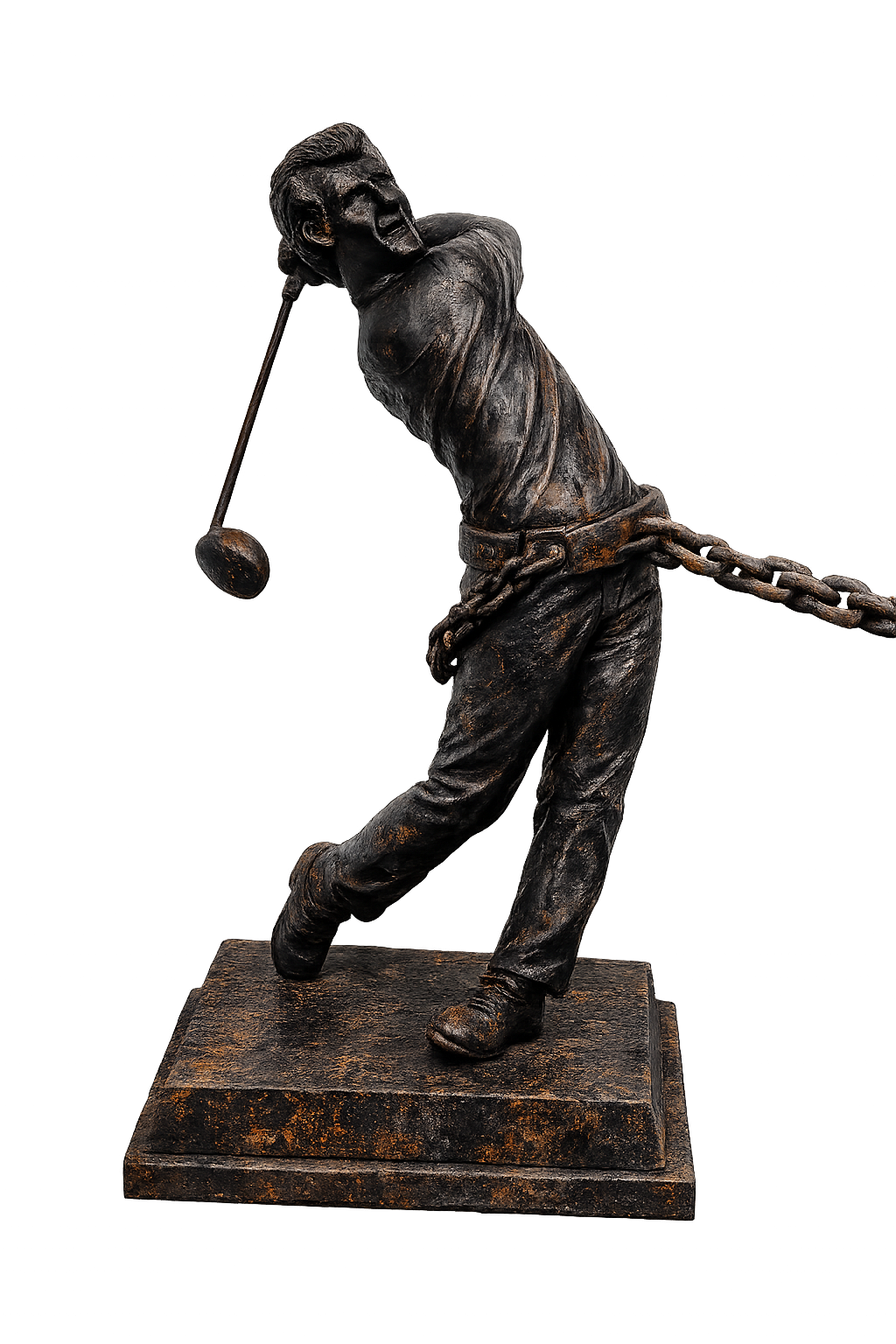
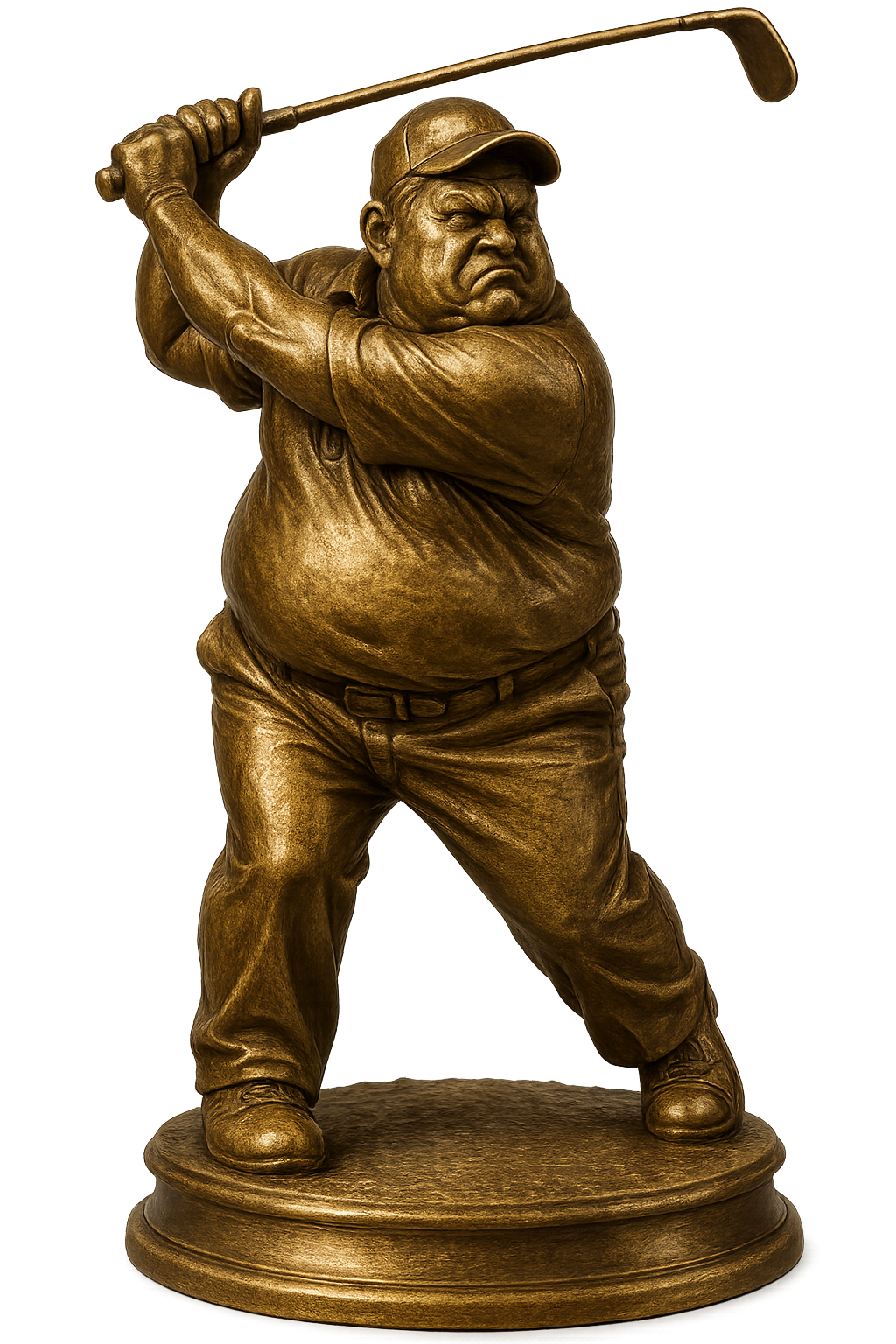
"Aha… some golfers look strong until the swing begins." The one who acts tougher than his body can handle. You’ve seen this guy step in with his forged iron like he owns the entire tee box. Shoulders wide, chin up, giving off that “watch this” attitude. But the moment he sets up, his legs soften, his knees dip, and his spine loses shape. He takes the club back like he’s about to crush it, but the downswing folds and the strike comes out thin or heavy. The ball barely moves, and all that big talk evaporates instantly. The Deck Chair.
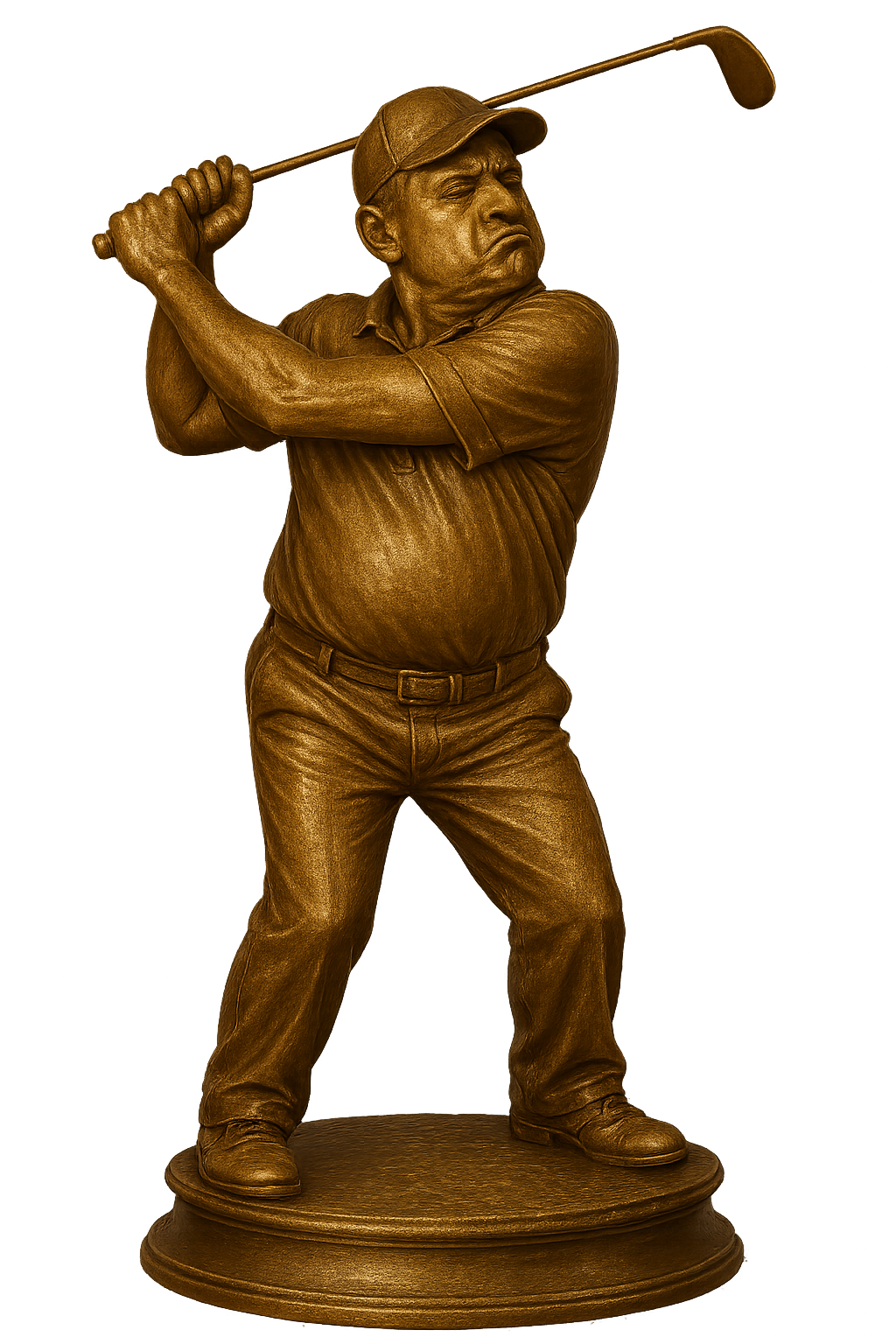
"Whoa… madre mía… volume can hide fear, but not impact." The one who talks big to hide how fragile he is. He stands tall at address, chest puffed, acting like he’s the best player in the group. He throws little comments around, little smirks, like he’s above the moment. Then he swings, his posture collapses, his arms take over, and the ball shoots off weakly. The louder he tries to be, the quieter the shot becomes. The Pouter.
"Ach so… voilà… tools can shine, but the swing tells the truth." The one who hides behind gear and numbers. He shows up with a tour spec driver, custom milled putter, and enough gadgets to run a small studio. He talks loft, lie, spin, angles like he’s giving a seminar. But when he finally swings, his posture never settles. The club comes down with speed but no control, and the ball fires sideways. All the gear looks impressive, but the swing exposes everything he tried to cover. The Gear Junkie.
"Ouf… ya rab… some golfers change the moment the course appears." The one who blames everything except the swing. On the range, he looks smooth and confident. On the course, he tightens up, rushes the swing, and sends the ball into the trees. Then the excuses start the wind, the tee box, the grass, the club, the universe. Anything but the truth. The golfer he pretends to be never seems to show up when it matters. The Range Pro.
"Ого… mon ami… pressure exposes most golfers, but not all." The one who looks like he’s about to fold until he doesn’t. You’ve seen him on the tee with his tour level driver, hands a little shaky, chest tight, looking like the moment is too big. Then he settles his feet, breathes once, and everything inside him firms up. His posture locks in, the swing starts smooth, and the ball launches on a strong, piercing line that nobody expected from the way he looked seconds earlier. The Fortress.
"Aha… wallah… quiet golfers are often the ones to fear." The quiet one everyone overlooks. He walks onto the tee without noise or swagger. No big warm up, no dramatic practice swings. His stance is simple, almost forgettable. Then he swings calm, connected, effortless and the sound off the face snaps heads around. The ball takes off on a tight, powerful flight. The silence becomes the warning everyone missed. The Silent Assassin.
"Madre mía… voilà… some swings look broken until the ball leaves." The messy looking one who turns chaos into brilliance. His setup looks loose, unpolished, even a little chaotic. Shoulders not perfect, stance casual, elbows wandering. People expect a disaster. But when he swings, everything falls into place. His weight shifts naturally, his chest stays over the strike, and the ball flies straight with a soft, controlled curve. The mess turns into something no one saw coming. The Magician.
Every one of these golfers, even the Magician, is searching for the same thing: Core Ignition. Some stumble into it by accident. I am going to show you how to find it by design. They look different, act different, and posture differently, yet many of them carry mechanics so consistent, so powerful, and so golden that they are far closer to the pros than they realise. And the best part is how obvious these patterns become once you know what to look for. We laugh, we point, we celebrate the little victories on the range or the course, and sooner or later we recognise something important. These labels are not just for the characters around us. They include us too. Because every golfer, no matter the personality or the disguise wrapped around the swing, is chasing the same spark. The moment the body organises itself. The moment the strike feels inevitable. The moment core ignition stops being luck and starts becoming something you can repeat. That is the quest. And now you know exactly where it leads.
THE GOLF IGNITION is here to uncover that hidden gold, tame the saboteur, and build a swing that is safe, repeatable, and powerful. It is a living story of mechanics, mischief, and mastery, with enough wit to make you laugh, enough science to keep you moving, and enough memory to stay with you long after the last page.
Acknowledgements
I would like to thank the doctors, the physiotherapists, and the golfers I have encountered who participated in this journey. May it be in person, through written books, or even from my eavesdrops, their insights gave the book both its human touch and its scientific backbone.
Deep gratitude to Doctor J. Parish, whose steadfast presence shaped this painstaking yet sweet foundational journey. She is the most solid and loving woman I have met.
To Wayne, my editor and friend, who tore apart my drafts and told me they were not classy enough. That honesty sharpened my work.
To Eric Morgan, like a brother; To Pacita and Blaise, whose support has been lifelong; and Verms, my sister, who strengthened my spirit.
Alejandro, thank you for sharing your wisdom and helping me see life differently in Europe. We carried on with strength, stayed humble, and found joy in the little things. I am looking forward to visiting your resort soon!
To my children: Anjali, who believed in both my foolishness and my wits; Izak, who dreams of continuing my golf device as an engineer (if he will, hahaha); and Cean, who lifted my morale when I needed it most. To the once-makulit kiddos Enzo and Miguel, now wise beyond their years. I am proud of you all.
To my ex-wife, whose presence shaped part of this journey and whose early support helped me stand where I am today.
To our brother Ogyok, the master of mischief, a natural genius, and a redeemed kind heart. You the man!
To our big brother General Pat Boon, the golden voice whose unbelievable steady support carried our families from start to finish. Thank you.
“Hedonist even to the smallest things matters.” To Dusan Novak, with whom I shared flights, meals, and endless talks about life’s pleasures across cultures and strong family values. Sir, I Salute You.
To Tomaz Mencinger, my mentor in the media world, who reminded me: “Follow your passion, follow your niche.”
To MT Giant, my friend with whom I cooked countless steaks, who stood by me when I was troubled.
To Master Chief Damien, the engineer whose brief encounter left me with lessons in professionalism and finesse.
To Coach Gurney, who believed in Hyperstryk Golf and provided reviews. His habit of ending with “no drama” struck me as a life lesson.
To the most extraordinary woman, Kelly, aka Sierra Bravo: we admire your beauty and supportive spirit. See you in Las Vegas, our dear mother.
And finally, to John Parish, the father of my lady, whose inspiration helped me build solid grounds. Your log house stands like a castle, a reminder of strength and foundation.

The Evolution of Core Ignition
Golf is one of the most precise mirrors of human movement. Every swing reveals how the body organizes itself under pressure: how it tilts, compresses, rotates, and either holds or collapses. As a performance trainer with over two decades of experience in physical therapy and sports biomechanics, I have studied these patterns not only to improve performance but also to uncover the deeper logic behind motion. This book is written for two audiences: the golfer who wants to train with clarity, and the coach who wants to teach with precision.
I created simple, teachable cues using practical language that resonates and delivers results and save your sanity from heavy biomechanic and medical terms. One of my favorites is: “Never let go of your core. Point that tailbone to the front.” It is not just a phrase; it becomes a command. When golfers hear it, they brace, their structure locks into place, and from that brace they discover unstoppable power.
A History of Tilt: From Rehab to Rocket Fuel
The concept of engaging the core is not new. In the 1970s, not on driving ranges but in rehab rooms, physical therapists used the posterior pelvic tilt to reduce back pain and stabilize the spine. By the 1990s, biomechanics labs revealed something more: the tilt did not just protect the spine; it loaded the core. Athletes in sprinting, gymnastics, and martial arts harnessed it to generate explosive movement. Golf, however, lagged behind. For decades, players swung from their hips instead of their pelvis. Rotation was taught, but ignition was overlooked.
Between 2022 and 2025, everything changed. Coaches began to notice that players who fired from their pelvis gained more control, more rotation, and better strike feel. The posterior tilt emerged as the ignition point for elite ball striking. Yet no one could measure it live, and no one could help players truly feel it until I did. With my background in physical therapy and sport specific movement, I became the first to capture the exact angle of posterior pelvic tilt inside a live device. Hyperstryk was born: a system that guides the tilt, locks the spine, loads the core, and lets golfers experience ignition in real time.
The Universal Language of Mastery
Core principles are the language of every great swing. Without them, the cues of
Nicklaus,
the torque of Tiger,
the rhythm of Rory,
and the precision of Hogan
remain foreign. With them, every sequence becomes teachable and every swing becomes yours to command. The artistry of
Seve,
the discipline of Faldo,
the power of Daly,
the consistency of Els,
the creativity of Mickelson,
and the modern dominance of McIlroy and
Koepka
all prove that mastery is never an accident. Even
Bryson DeChambeau
stands as proof that innovation can reshape tradition when built upon unbreakable principles.
These legends are just the beginning. There are simply too many elite golfers in the PGA with their trademark swing to name them all here, but as we move into the following chapters, you will see that every great ball striker shares the same underlying mechanical truth. We start by getting clear on the basics. Once that groundwork is in place, the habits of the greats begin to make sense. Step to the ball. Watch. Focus. Move. The swing unfolds not as guesswork, but as understanding made visible.
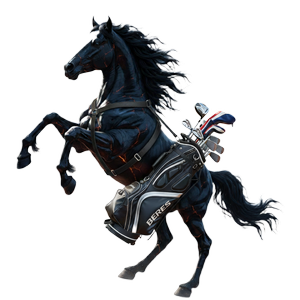
The 7 Horsepower in Golf is Forge With Common Sense
Most golfers are victims of a massive misconception: they believe the golf ball responds to effort. We see a long fairway and our instinct screams at us to "muscle it," tighten our grip, and lash out with our arms. But common sense tells us that golf is a painful paradox; in this game, the harder you try to create force with your limbs, the more speed you actually bleed away.
Think about it: Have you ever noticed that your longest drives often feel like the ones where you "hardly tried"? That is because synchrony is the true mother of speed. Before we dive into the enjoyable mechanics of the swing, you must understand that aside from the lower legs and arms, a hidden horsepower is waiting to be summoned.
What if the secret to your max power is found in the stability of your frame? Can you imagine the violence of 7 horsepower being released from a body that feels like solid granite? If your foundation is shaking, how can your engine redline? In the following pages, we will build the foundation and enjoy the mechanics of the motion, but Chapter X (the final engineering supplement of this book) will be the key that helps you fully understand and unlock this secret. Let’s summon solid stability first.
The Golf Swing Ignition
PART 1
THE GENESIS
|
PART 2: THE PROTECTOR
When the Back Is Put to the Test |
|
| Chapter | Title |
 4
4
|
Your Back Does Not Lie
The Pain Is Your Alarm
FREE
|
 5
5
|
Structural Advantage
Strength and Stability for Powerful Rotation
FREE
|

|
PART 8: THE ELITE IGNITION
Advanced Control and Pressure |
|
| Chapter | Title |
 17
17
|
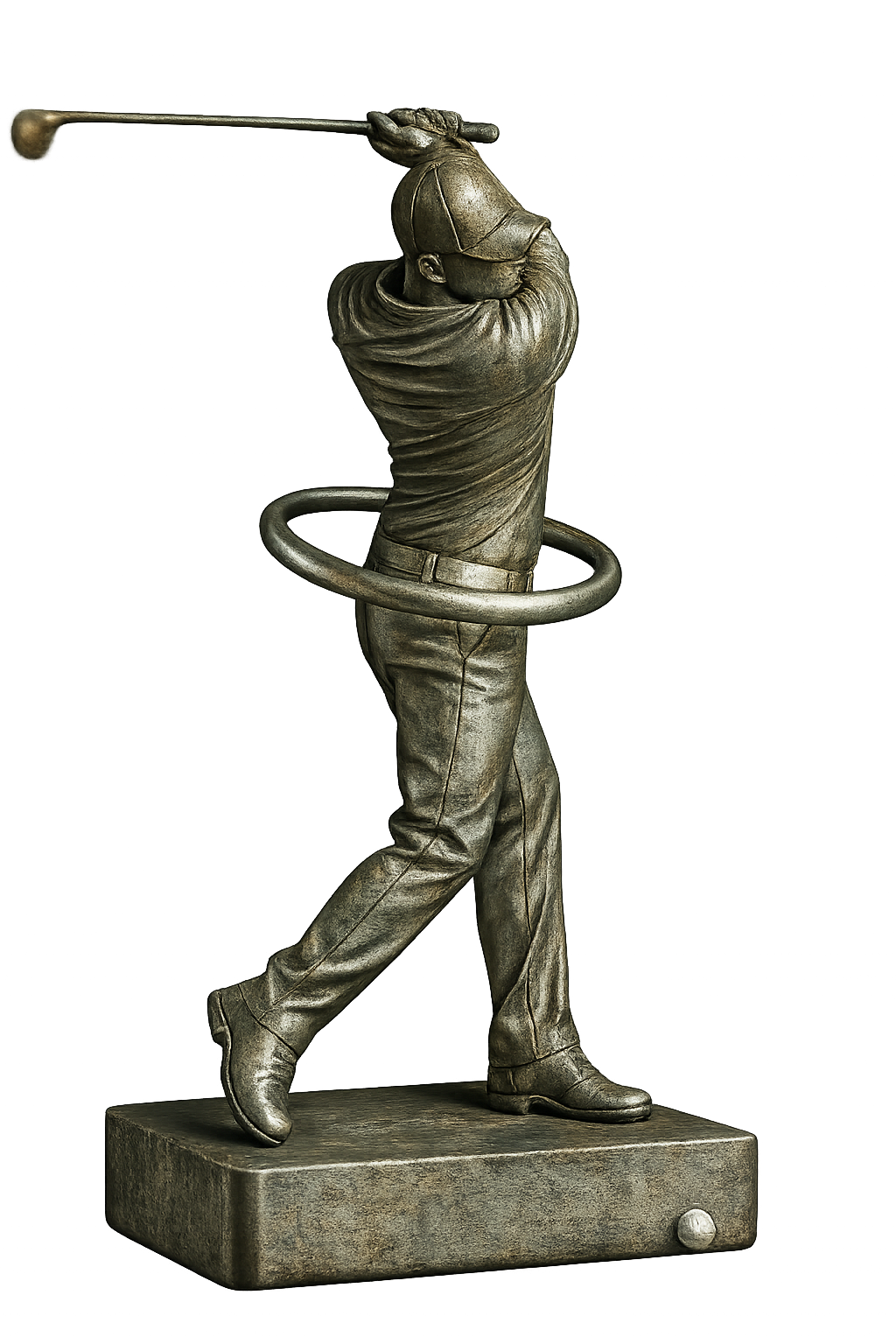
The Pelvis Is the King
Fire the Glutes and Lock the Core
MEMBERS ONLY
|
 18
18
|
Swing Deformities
Spot the Flaws and Fix Them Fast
MEMBERS ONLY
|
 19
19
|
Big or Small
Understand How Different Bodies Move
MEMBERS ONLY
|
 20
20
|
The "EGO" Put To Test
Breathe, Hold the Middle, and Strike with Feel
MEMBERS ONLY
|
 21
21
|
Tame the Core
Stay Firm and Fire with Control
MEMBERS ONLY
|
|
PART 9: THE MASTERS IGNITION
Inspired by Ben Hogan’s study of power, mechanics, and fundamentals of the swing. This part presents the concepts as Hogan might explain them, adapted to modern biomechanics and your personal signature. |
|
| Chapter | Title |
 22
22
|
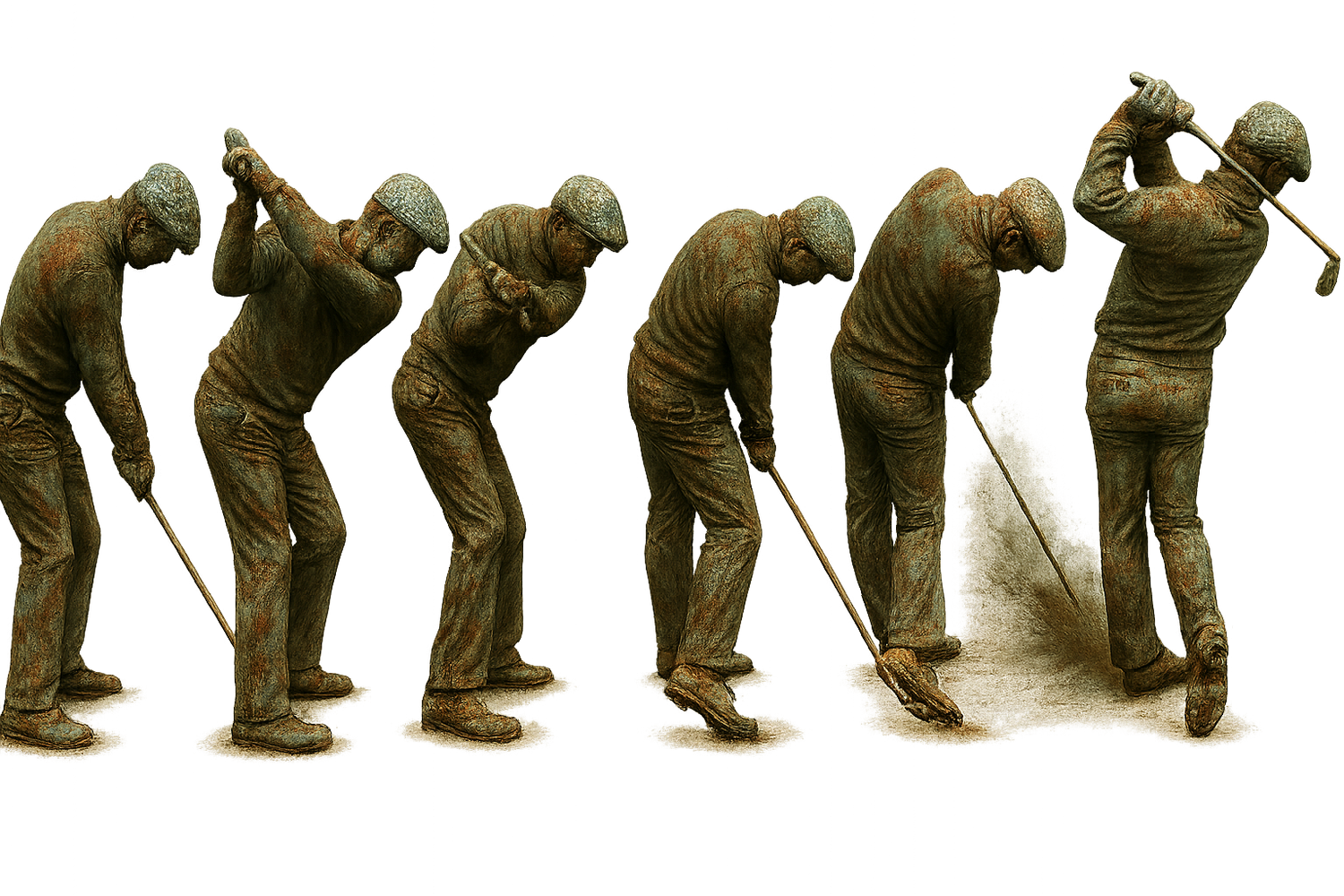
The Vertical Launch
Using the Ground as Fuel for Maximum Distance
MEMBERS ONLY
|
 23
23
|
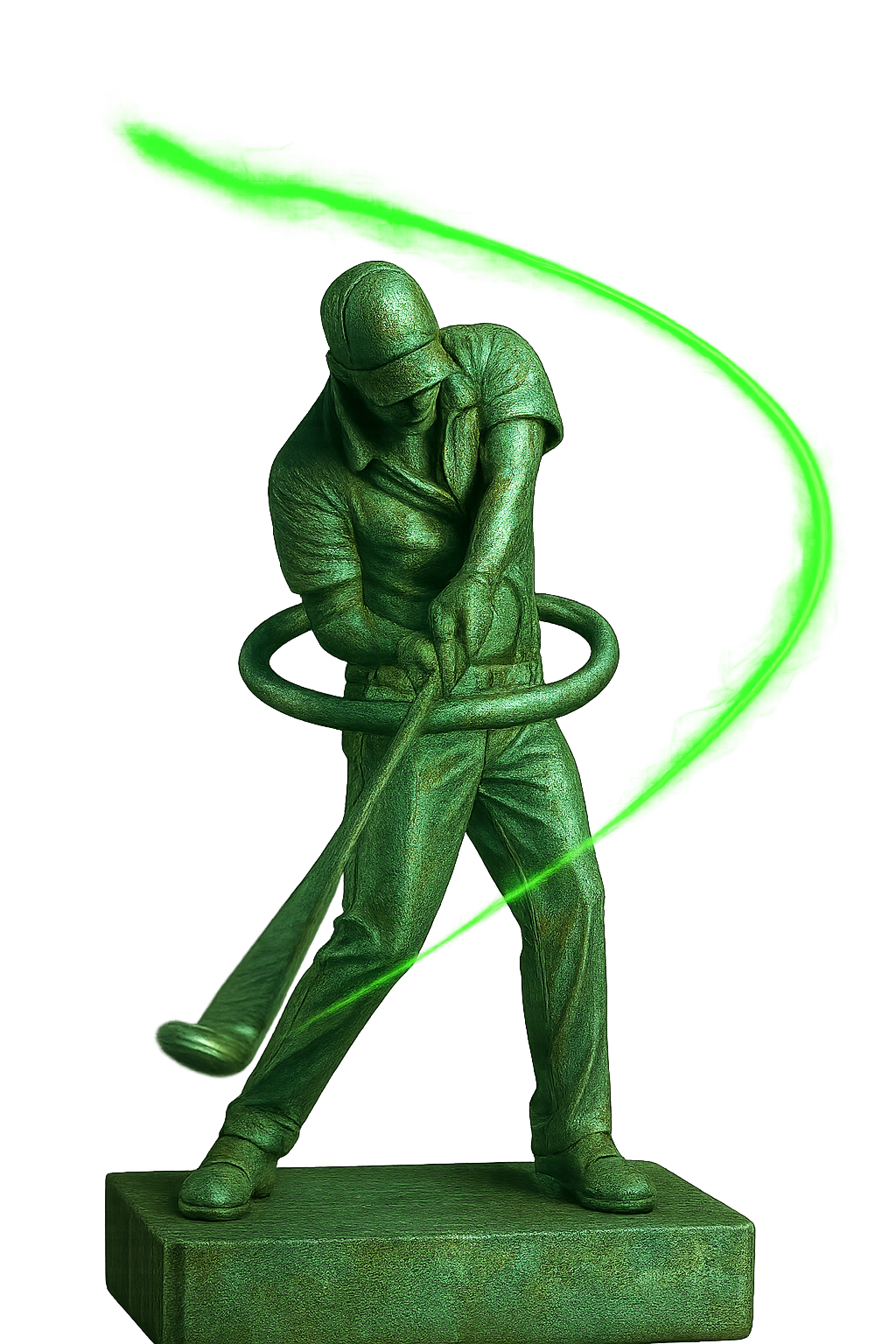
Core of the Champions
Signature Moves of the Greats for Explosive Power
MEMBERS ONLY
|
 24
24
|
The Master’s Finish
Achieve Subconscious Permanence in Every Swing
MEMBERS ONLY
|

QUICK START GUIDE
Biomechanics can sound like a scary word but do not let the science intimidate you. This book is designed to be your partner on the range and not a lecture in a classroom. To keep things simple and ensure you never get lost, every chapter follows a specific flow using metaphors.
In this book, I use six professional roles as metaphors to give you a mental shortcut for understanding how your body moves. Instead of memorizing long medical terms, you simply step into these roles to solve the problem. Think of it as having six experts standing behind you on the tee box.
1. See like a Physiotherapist: The Evidence
We look at the bones of the movement. This metaphor helps you see through the skin to the skeletal reality underneath, providing observation and analysis. We strip away the distraction of the swing to show you exactly how your body is designed to move. There is no guessing, only clear pictures of how the machine works.
2. Think like a Doctor: The Damage Report
We look for the Traitor. Using this metaphor, you become a clinician identifying the common habits or Trademarks that cause pain or make you lose distance. This is your phase of diagnosis and problem identification, where we find the biological problem so we can fix it for good.
3. Build like a Carpenter: The Foundation
We focus on the structural integrity of your setup. This metaphor teaches you the importance of precision and alignment, ensuring your stance and posture are level and sturdy. Just as a Carpenter ensures every joint is flush and every angle is square, you use this phase for constructing your ideal starting position that can support the force of your swing without shifting or collapsing.
4. Breathe like a Pilot: The Checklist
We stabilize the cockpit of your mind. This metaphor helps with mental and emotional regulation, allowing you to regulate your nervous system and clear the mental fog that leads to tension. Like a Pilot facing turbulence, you use specific breathing patterns and a mental checklist to lower your heart rate and sharpen your focus before every shot.
5. Do like a Lawyer: The Verdict
We give you the solution. This metaphor gives you the authority required for decision making and action planning, where you deliver a final Verdict, a simple one sentence command that fixes the issue. We then give you a Tactical Drill to take to the range so you can feel the change instantly.
6. Play like a Champion: The Blueprint
We bridge the gap between the science and the score. This metaphor is all about execution and performance. It allows you to look at a pro’s signature move and deconstruct the mechanics behind it. By understanding the why behind the how, you can mimic their elite results through a safe, repeatable swing that works for your specific biology. You don't just copy their look; you copy their efficiency.
Why Do We Need Them
This is the beauty of being a golfer. The reason we use these specific professions is that they are constantly working like specialized departments inside your body. Being an exceptional golfer means coordinating these internal experts. You need your internal team, the Physiotherapist, Doctor, Carpenter, Pilot, Lawyer, and Champion, all specializing in their own crucial role within your single, mechanical swing.
The Result: Your Pictographic Memory
By following this path, you will develop a Pictographic Memory. You will stop seeing a messy blur of motion and start seeing the swing in high definition. You will train your brain to visualize the internal mechanics and lock in those images for good.
You do not need to be a scientist to master this. You just need to follow the investigation. By the end of this book, you will not just be trying to play better golf, you will have a Core Shield that protects your body and an Ignition that powers your game for years to come.
"Ignite that powerful strike within your own mechanical swing."
CHAPTER 1
THE CODEX ORIGINS

Igniting the Core
Every great motion system begins with a single idea that reshapes how the body understands movement. The Codex is the foundation of your transformation. It reveals the hidden structure behind balance, rotation, and power. This chapter introduces the core principles that ignite the system and prepare the athlete for everything that follows.
What if the secret to an effortless swing was hidden inside a codex passed to you before you were even born? Movement itself rises from a blueprint etched into your biology long before your first breath. In the womb, it protected you, shaped you, and laid the foundation for every step you would ever take. This codex did not sleep or think. It simply worked, coordinating the very rhythm of life. As you grew, crawled, and learned to stand, the codex transformed with you. It adapted, refined, and tuned your body for balance and stability. Eventually, when you gripped a golf club and stepped onto the course, the codex was already there. It was hardwired into your nervous system, waiting to guide each swing with precision and power.
I. THE STEALTH MISSION
The alarm doesn't ring; it vibrates on your wrist. You kill the vibration with lightning speed, a single, surgical slap like you’re swatting an insect a millisecond before it bites. Total silence. It’s 5:30 AM. Operation: Golf has begun.
Like a quiet agent. You slip from the sheets, shifting your weight in fractions so the mattress doesn't groan. Your wife has spider-senses. She can feel a change in the room’s pressure or the ghost of a tremor in the floorboards. You navigate the shadows like a wraith, toes sinking into the carpet to dodge the treacherous, loud hardwood.
"At the closet, the door is a sliver of darkness. Inside, the golf clubs glow with a faint lunar light, the polished steel emitting a cold and lethal hum. These are custom-fit extensions of your own reach, born in Japanese fire and hammered by a master blacksmith with the soul-deep precision of a katana. Last night’s surgical cleaning left the grooves hungry. You pull the travel zip, a silk whisper. Total silence."

You make it outside into the quiet morning air. You walk past the Maybach S-Class in the driveway. You glance at the garage housing the Bugatti Tourbillon, the 1970 Chevrolet Chevelle SS, the Rolls-Royce Spectre, and the Cadillac Celestiq. You even consider the helipad; for a split second, you think about flying the chopper, but oh lord, that is louder than a lawnmower in a library.
You hit the pavement barefoot, moving fast and silent for two full blocks. The bite of the cold ground is your first real contact with the world. You feel the heat of prying eyes. The curtain swipers are already at their posts, peeping through slats to track your silhouette.
You reach the old 1967 MGB Roadster four-cylinder. A machine built to be quiet. As you pull away, your chest tightens with a heart-pounding calmness. The world is still asleep, but you are wide awake, heading out to play a perfect round of golf.
The Rendezvous
I roll into the club lot and there they are. The usual low handicap sharks are leaning against their bags.
"Morning, Doc," one of them says, "Ready to give that back of yours another 1,400 pound beating?" A round of knowing laughter follows. They understand the stakes, the obsession.
"Nice breakout, Houdini," one chirps, not even looking up from his glove. "We saw you pushing that MG down the street. Did the Commander in Chief actually let you out, or are you on the run?"
The group roars. They get the obsession.
I gave a wink of success. Grabbing my bag. "Let's go. Today is about the final score and your new deal 'whatever' and a cold light beer after we are done."

The Kinetic Symphony
You stand over the ball, and the world goes silent. Your left eye locks onto your line. You start the Takeaway, and the ground becomes your fuel. You can literally feel the energy traveling up from your feet, through your legs, and making your hips a coiled spring of pure power. The high tech fabric of that J.Lindeberg polo shirt stretches, providing zero restriction, allowing your body's sequence to flow perfectly.
Then, the transition happens. All that stored energy is a raw force of nature that has to be channeled. It moves from your legs, into your hips, through your chest and shoulders, and down your arms into the precise pressure of your grip. For a split second, you feel the high tech graphite in your club bend like a whip. Then “BOOM.”
The club meets the ball in that crisp, compressed strike. That's the Pure Feel. It's the amazing sound of all that kinetic energy being released. In that moment of impact, you feel like Superman. You feel invulnerable. You’ve just generated massive raw energy and funneled it into a tiny white sphere.
But have you ever considered that the perfect thwack of your golf ball is actually the sound of a 1,400 pound explosion being absorbed by your spine? Here is the Kryptonite: Your spine isn't made of steel. While you feel like a Man of Steel in the follow through, your lumbar discs are actually screaming under a 1,400 pound blast. That superhero feeling is a neurological trick; your brain ignores the micro trauma because the dopamine of the perfect shot is too loud. You think you are flying, but without a braced core, you are actually crashing.
The Bag of Addictions
We all have our complicated relationships with our clubs, sharpened and honed last night:
The King (The Driver): The ultimate addictive challenge. It makes you feel like a King when the launch is right, but it is a monster that punishes your spine when the timing is wrong.
The Blades (The Irons): Those super reliable mid irons that feel like an extension of your own soul. You sharpened these grooves last night to ensure they bite the ball with a crisp, buttery feel.
The Scalpels (The Wedges): They get the job done with finesse. While they lack the ego boost of the long drive, their precision is what saves the business deal when you’re 50 yards out.
The Finisher (The Putter): After the violence of the 1,400 pound blast, you reach the green and switch to the Putter. This is where the intensity shifts to the micro stability required for a dead aim finish.
The Promise (The Fairway Woods): The clubs that promise glory from the long grass but can sting your hands and vibrate right up to your teeth if your core disengages.
The Impact Strike on Your Spine
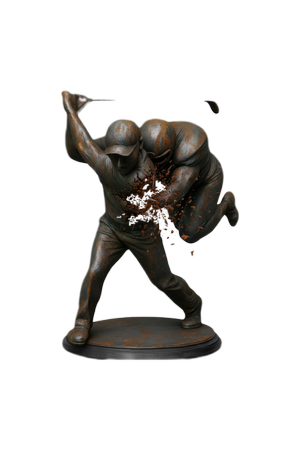
Behind that beautiful sound is a hidden reality. The modern golf swing is a surprisingly violent event for your body. At the exact moment of impact, the force you generate essentially results in an NFL player tackling your lumbar spine while you brace, trying to absorb the tremendous force without getting stunned. Biomechanical studies conducted by Hosea et al. (1990) proved that the peak compressive load on the low back can exceed eight times your total body weight.
The Barbell Reality Check
For a golfer weighing 90kg (200lbs), a full driver swing is physically like having someone instantly drop a 720kg (1,587lb) barbell onto your shoulders. Dr. Stuart McGill, a world-renowned expert in spine biomechanics, emphasizes that these forces are comparable to the impact a professional football player feels when hitting a tackling dummy. Your vertebrae must absorb this entire blast in less than 0.2 seconds.
Why Golf Hurts
When your core is not engaged correctly, all that force goes into your joints instead of the ball. This causes the hidden damage that researchers call the missing link in performance. Each club in your bag creates a unique tactical threat:
The Driver (The Torsional Monster): Jim McLean introduced the X-Factor to describe the rotational gap between hips and shoulders. High-speed drivers maximize this stretch, but without a braced core, this torsional stress becomes the primary cause of disc herniation and oblique strains.
The Irons (The Vertical Hammer): Research by Worsfold et al. (2007) found that mid-irons often produce higher maximal vertical Ground Reaction Forces (GRF) than the driver due to a steeper angle of attack. These vertical forces travel up the kinetic chain, leading to lead-side hip labral tears and knee instability.
The Wedges (The Shockwave): Hitting fat shots creates a sudden deceleration. This transmits a shockwave of force directly into the wrist. Studies by McCarroll et al. identify this as the leading cause of Medial Epicondylitis, also known as golfer’s elbow.
Sport Comparison: Unlike football players who expect a tackle and brace for it, golfers generate huge forces from a static stance. It is an internal tackle your body does to itself without warning.
The 30 MPH Collision
Biomechanical research by Lindsay and Horton (2002) indicates that the shear and compressive forces on a golfer's lumbar spine are comparable to the forces experienced by an unrestrained passenger in a 30 mph car crash. Without a braced core, you are essentially crashing your spine into a wall. Unlike football players who expect a tackle and brace for it, golfers generate huge forces from a static stance. It is an internal tackle your body does to itself without warning.
The Hope: The Survival Blueprint
The pros don't just play golf; they manage force like elite athletes. They protect their spine like a knight putting on armor before a battle. This book is your manual for survival. The core is the missing link because, as Dr. Stuart McGill teaches, it acts as a biological brace that converts segmental shearing into manageable energy.
You will learn to:
Activate the Shield: Use the Posterior Pelvic Tilt to instantly lock your spine and create an unbreakable internal brace.
Fire the Heavy Engine: Shift your power source from fragile wrists to massive core and glute muscles.
Survive the Aftershock: Master the recovery phases to safely slow down 720kg of force without snapping a joint.
Swing forces are fast, unforgiving, and brutally honest. If you do not have a system to contain the horsepower, the swing will eventually break the athlete. The Core Secret is your guide to owning the force, protecting your body, and striking the ball with power you can sustain for a lifetime.
The Silent Killer: The Putter
We often forget the putter because it lacks the violence of the 1,400 pound blast, but it is actually the club with the highest cumulative injury rating for your joints. Research into the biomechanics of the putting stroke shows that the prolonged, static, flexed posture required for a "dead aim" puts a massive constant load on your lower back.
If you try to putt 9 yards into the hole and strike it to 900 yards like the boy from Krypton, staying frozen in a rigid, over-tensed stance for hours on the practice green, you will definitely hurt your discs and tear your tendons. Studies show that a slouched or hyper-static putting posture can increase load on the lumbar discs by up to 50 percent. You think you are being precise, but your tendons are screaming under the static tension.
But don't worry. I got you.
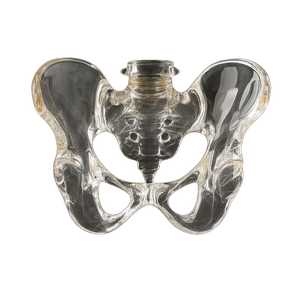
WHERE IS THE CODEX?
Let's get serious now. This codex shaped you in the womb and passed its blueprint to you at birth. From your first crawl to every stumble, every stride, and finally to the moment you stood tall, you moved through this codex. Eventually, you picked up a club and stepped onto the golf course, carrying that same codex into every swing.
Unlike the mind, the codex works intuitively. It senses, it reacts, and it organizes movement naturally without conscious thought. At the center of this system is the pelvis. It is the anchor that balances power. It is designed to stabilize, coordinate movement, and fine-tune precision. Within it are two competing commands. They are not enemies, but when they clash, they can act like unruly forces. They create chaos: injury, disruption of the swing sequence, and a shrugging “c’est la vie”. The belief that "that’s just life" and there is nothing you can do.
These forces have no care for order. If the pelvis is napping, they take over, pulling the body out of sync and making movement awkward. Only when the pelvis leads, carefully coordinating the commands in sequence, does motion flow smoothly and efficiently. This is how energy transfers through every joint in the correct order.
Balance of power is all about timing. One joint moves first, the next follows, and each link in the chain passes energy naturally. When this timing is right, the swing feels effortless, powerful, and controlled. Your joints stay safe, your movements remain efficient, and your body performs with intelligence. Mastering this intuitive balance of power lets the pelvis codex guide every motion naturally. It turns every step, stride, and shot into an act of precise, effortless performance.
II. THE LESSON: THE INTUITIVE BLUEPRINT
Those pros on tour remind us of this truth. How do they do it? Their arms look different, their styles do not match, and yet every swing is smooth, straight, and completely in control. You start thinking it must be how they rotate, or maybe it is the grip. Then another thought hits you. They swing differently, but they all share something in common.
Take Bryson DeChambeau. His swing looks like it came out of a physics lab with one-length irons and an upright posture built for raw power. Then look at Rory McIlroy. His swing is the epitome of style and efficiency, combining elegance with explosive torque. And Tommy Fleetwood? Watch his hands and rhythm through impact. These are different styles and different looks, yet all three share one hidden commander: the deep core rotation that organizes the body.
Around the pelvis grew a muscular orchestra. The gluteus maximus powers hip extension and keeps the body from collapsing backward. The gluteus medius and minimus hold the pelvis level when one leg lifts, preventing the body from tipping sideways. The iliopsoas pulls the pelvis forward and drives the leg upward, linking the spine to the femur in every stride. The hamstrings balance tilt and assist hip extension, acting as brakes against forward drive.
The abdominal muscles wrap the pelvis like a belt. The rectus abdominis controls forward tilt and braces against spinal load. The obliques manage rotation and side tilt, while the transversus abdominis acts like a deep corset, compressing the abdomen and locking the pelvis into stability. Deep inside, the pelvic floor forms a hammock that supports the organs and maintains pressure. This orchestra is what the pros are conducting, even if their arms and styles look different.
You watch their videos in slow motion and still cannot quite see it. Where should you look with the naked eye? Not at the hands or the club, but at the pelvis. The belt line moves first, the hips set the sequence, the trunk follows, and the arms ride the rotation. The source of power and control is hidden inside.
Of course, their clubs are excellent. TaylorMade, Callaway, Honma, Srixon, Miura, PXG, and Titleist are all engineered with precision. But even the most advanced equipment cannot deliver control without the anchor and the chain. The anchor is the deep core, the chain is the sequencing of hips and trunk, and the ship is the club. Without the anchor and chain, the ship drifts.
The frustration builds. Lessons, drills, and thousands spent, yet the swing still fights you. The back aches and the effort feels bigger than the reward. Why does their swing glide while yours feels like a grind?
III. THE MUSCULAR ORCHESTRA
Around your pelvis grows a muscular orchestra:
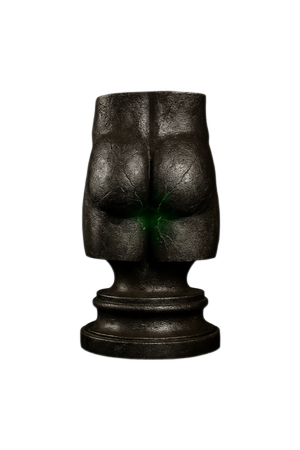
The Powerhouse
The Gluteus Maximus drives your extension while the Medius and Minimus hold your pelvis level so you do not tip sideways.
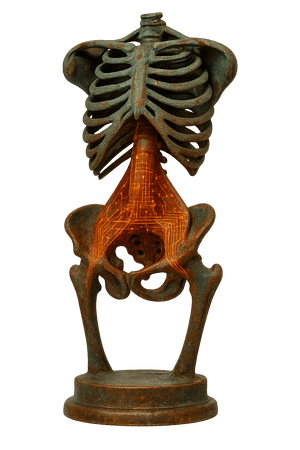
The Part That Links
The Iliopsoas connects your spine to your legs, driving every stride and every turn.
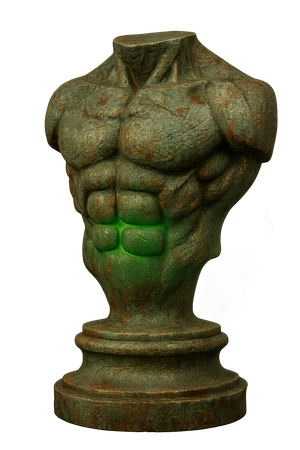
The Belt That Holds
The Rectus Abdominis braces you, the Obliques manage your rotation, and the Transversus Abdominis acts as a deep corset, locking you into stability.
The pros are conducting this orchestra while most golfers are just making noise. They are not looking at the hands or the club; they are watching the Belt Line. The belt moves first, the hips set the sequence, the trunk follows, and the arms simply ride the rotation.
IV. THE ANCHOR AND THE CHAIN
We may have the finest equipment but even the most advanced engineering cannot deliver control without the Anchor and the Chain.
The Anchor: Your deep core.
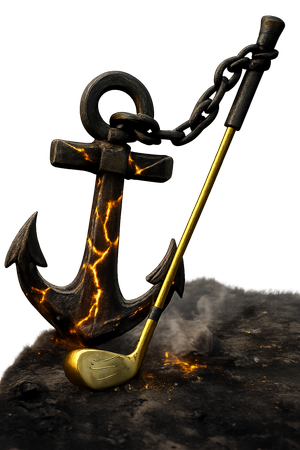
The Chain: The sequencing of your hips powered by your core ignition and trunk.
The Ship: Your club.
Without the anchor and chain, the ship drifts. This is why your swing feels like a grind while the pro’s swing feels like a glide. You are fighting the Saboteur instead of conducting the Orchestra.

V. THE ELITE GHOSTS: Why Even the Greats Face the Phantoms
Even the greatest legends in history have dealt with stubborn faults. The difference between a champion and a weekend warrior isn't the absence of these ghosts; it's the ability to lock their movement onto steel tracks that the rest of us haven't found yet.
They survived through master-level compensation, but for the average player, these same faults are the derailments that end the season.
Here is how these five mechanical failures manifest in the wild:
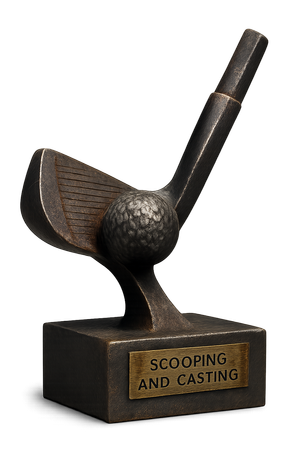
1. Scooping and Casting: The Battle of the Hands
Why this happens to others: Most players feel the weight of the clubhead and try to "toss" it at the ball. Without a rotating core to pull the club through, the hands take over in a desperate attempt to create speed, resulting in a weak, upward flick.
The Professional Exception: Phil Mickelson is famously handsy, but his release is not a scoop. He uses massive core torque to time his wrist release with such precision that it becomes a weapon rather than a weakness.
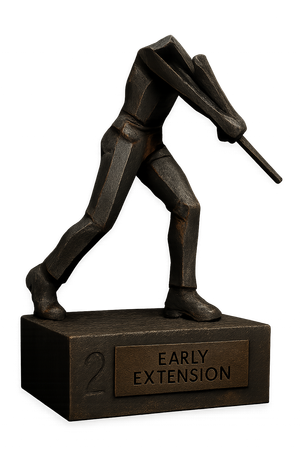
2. Early Extension: The Thrust for Power
Why this happens to others: When the core cannot stabilize the spine, the brain senses a loss of balance. To prevent falling, the body thrusts the hips forward. This saves balance—but kills the swing.
The Professional Exception: Jack Nicklaus and Rory McIlroy exhibit vertical thrust, but theirs is intentional ground-force production, not a survival reflex.
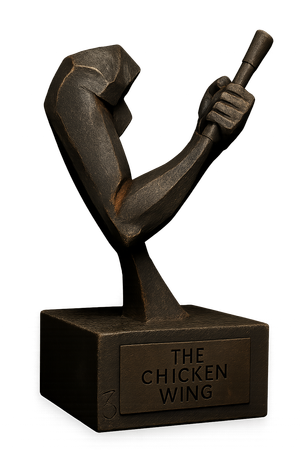
3. The Chicken Wing: The Steering Mechanism
Why this happens to others: When the torso fails to rotate out of the way, the lead arm has no hallway to swing through. The elbow collapses inward as the only escape route.
The Professional Exception: Jordan Spieth’s version is not a bailout. His core clears so well that his arm becomes a steering tool, not a compensation.
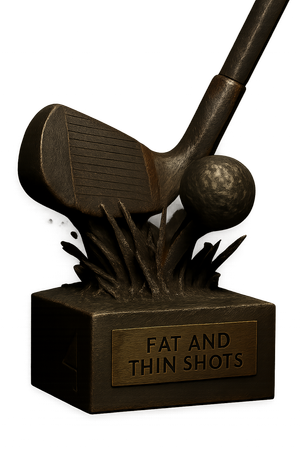
4. Fat and Thin Shots: The Shifting Foundation
Why this happens to others: If the epicenter shifts even two inches laterally, the bottom of the arc shifts with it. Clean contact becomes luck.
The Professional Exception: Scottie Scheffler’s feet dance, but his epicenter stays bolted to his spine angle.
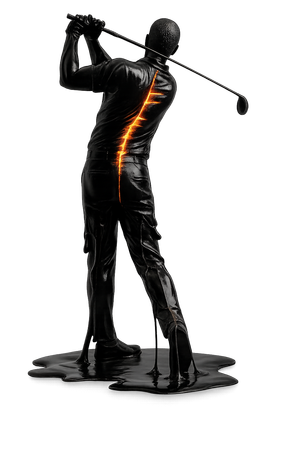
5. Absolute Injuries: The Mechanical Tax
Why this happens to others: When the core sleeps, the lower back and elbows absorb the impact until they break.
The Professional Exception: Even legends like Tiger Woods and Fred Couples paid the price for years of elite power without consistent epicenter governance.
The Practical Solutions
In this book, you will find the most definitive, solid solutions that follow the scientific flow of biomechanics. By moving from the center outward, we lock in a rotating core that maintains spine angle and pulls the arms through the hitting zone with effortless authority.
VI. POSTURE BEFORE THE SWING
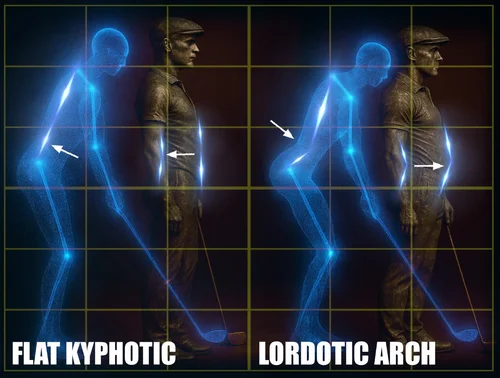
Posture is the silent architect of the golf swing. Before the club moves, before the hips rotate, and before the wrists hinge, posture decides what is possible. Studying posture means studying the ability of the body to organize itself for motion, force, and recovery. It is not just about standing tall; it is about how the joints align, how the muscles stabilize, and how the body prepares to rotate without collapsing.
In golf, posture is the foundation of every phase. At setup, it defines the spine angle and pelvic tilt, creating the blueprint for the swing path. During the backswing, it determines how much rotation the torso can generate while preserving balance. At impact, posture controls how force is delivered; the body either stays stacked or folds under pressure. After the follow-through, posture reveals how well the body absorbs and recovers from rotational stress.
🔗 Scientific Foundations
- Dr. Stuart McGill: Research on spine biomechanics demonstrating that "stiffening" the core is essential for maximizing force transfer and injury resilience during elite rotational pulses.
- Hodges & Richardson: Foundational study on "anticipatory" postural adjustments, proving the central nervous system activates the core (TrA) in advance of limb movement to stabilize the spine.
- Sahrmann MSI Model: Clinical evidence showing that precise postural alignment and movement system impairment (MSI) syndromes directly dictate rotational control and foot pressure symmetry.
- Behm & Vasudevan: Surface electromyography (EMG) analysis confirming that sequential neuromuscular activation (from core to limb) is the primary driver of clubhead velocity.
⚖️ The Verdict: Awakening the Pelvis Codex
The Evidence: Standing on the green, you have a choice. You can continue to rely on the Human Struggle. The endless analysis, the flickering hands, and the frustration of a swing that collapses under pressure. Or you can awaken the Pelvis Codex. The pros on TV aren’t lucky; they are simply following the blueprint. They have stopped fighting the orchestra and started conducting it. When the belt line moves first and the anchor holds firm, the Superhuman shot becomes a repeatable reality.
The Sentence: Ignoring your core does not make you a better student of the game; it makes you a victim of the grind. You have been staring at the clubhead, but the secret was always at your center. You are hereby sentenced to abandon survival mode and embrace the internal command system that governs every elite strike.
The Ruling: It is time to stop surviving the round and start owning the move. When the center leads, the chaos ends. When the anchor holds, the orchestra obeys. When the Pelvis Codex awakens, the athlete replaces the struggler permanently.
CASE CLOSED.
"Stop riding your swing. Start driving it."
CHAPTER 2
THE COMPLETE GOLF ATHLETE
Inside The World of Modern Golf
The modern golfer is no longer just a swinger of the club. They are a complete athlete who understands how strength, mobility, and coordination shape every shot. This chapter explores the evolution of the golf athlete and reveals the physical qualities that separate consistent performers from struggling players.
I. FROM SWING-THINKER TO MOTION-MASTER
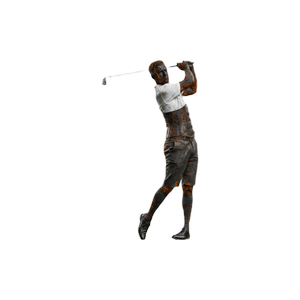
Your mission is to upgrade your identity. Most players are "Swing-Thinkers," obsessed with club positions, hand angles, and ball flight data. Of course and why not! That's a nice thing to get informed and to see how much you can go the distance, right. To unlock the core ignition, you must become a "Motion-Master." You must accept one absolute truth: your body is the Engine, and the golf club is just the Steering Wheel. If the engine is dead, no amount of steering will get you down the fairway.
II. THE AVIATOR'S EQUIPMENT
To make the One Simple Move work, the Pilot must maintain three basic structural qualities. These are not options; they are the requirements for flight.
Functional Stability: The strength to hold your posture firm against the violent pull of a 100mph swing.
Segmented Mobility: The ability for your hips and upper back to turn freely without dragging your spine out of position.
The Master Ignition: The ability to fire your core before anything else moves. This is the "Spark Plug" that connects your physical strength to the clubface.
III. TWO TYPES OF PILOTS
• The Struggler: Relies on luck and timing. Because their core is asleep, they must "rescue" every shot with their hands. Their drives are weak, their back is tired, and their putting is a guessing game.
• The Athlete: Knows a great drive is the result of a body ready to move. They don't "try" to hit it far; they ignite their core and let the machine do the work. They are balanced, calm, and in control.
IV. THE ACCURACY SHIELD
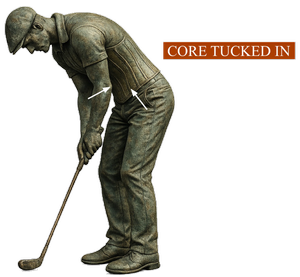
This upgrade is not just about raw power; it is about precision. When you stop trying to "hit" the ball with your arms and start igniting the movement from your center, you create an Accuracy Shield.
A strong, active core gives you the rock-solid base needed for Dead Aim Putting. By letting the core drive the rhythm, you turn your still setup into a launchpad. The clubhead stops wobbling because the Pilot is locked in.
🔗 Kinematic & Athletic Research
- Fleisig et al.: Kinematic analysis showing how multi-joint coordination directly maximizes clubhead speed while minimizing joint stress.
- McHardy & Pollard: Comprehensive study linking specific athletic conditioning to the prevention of overuse injuries and mechanical consistency.
- Hume et al.: Evidence on the "X-Factor" and the role of neuromuscular hip-trunk coordination in generating peak rotational power.
⚓ The Verdict: The Pilot's Command
The Evidence: The upgrade is complete. You are no longer a passenger in your own swing, hoping for a good result. You are the Pilot. You have moved from the Human Struggle of arm‑swinging to the Athletic Command of core‑ignition.
The Ruling: The club is no longer a heavy tool you are trying to manipulate; it is an extension of your Epicenter. You have upgraded from a manual struggle to an automated system. If the engine is ignited and the base is stable, the ball has no choice but to obey.
CASE CLOSED.

"You're done polishing the arms of Big Ben; don't forget to repair the engine."
CHAPTER 3
X-RAY VISION
Tracking the Source of Motion
Most golfers see only the surface of the swing. They watch the club, the arms, and the ball. But the true source of motion lives deeper in the body. This chapter teaches you how to see through the noise and identify the origin of every movement so you can diagnose flaws and build a motion that is powerful, stable, and repeatable.
I. THE DOCTRINE OF HYPERFOCUS
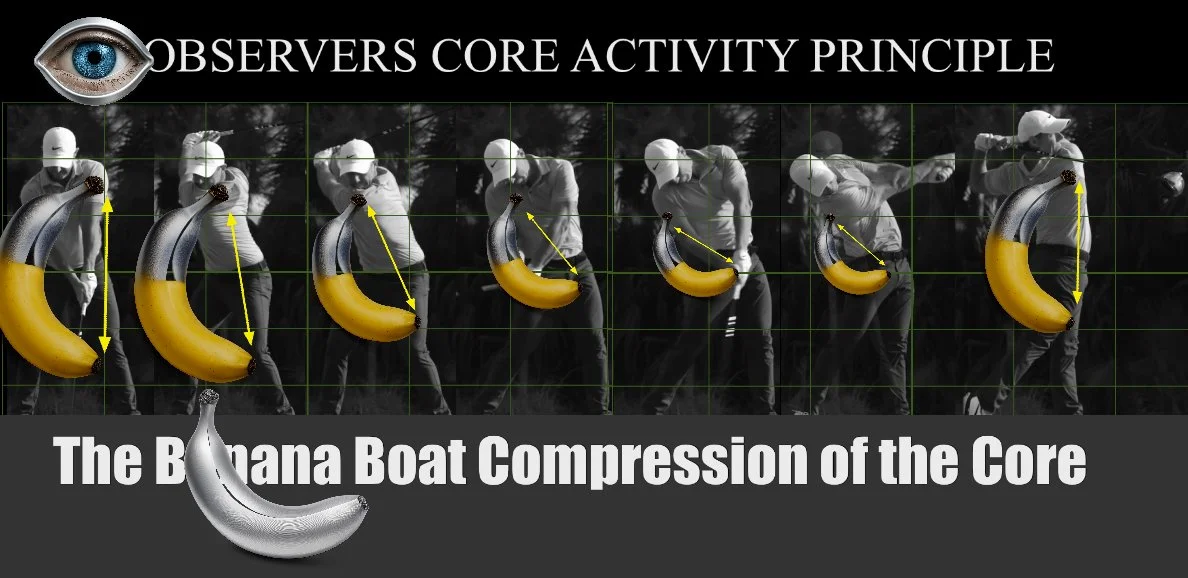
On the practice range, most players look everywhere and see nothing. They chase clubface patterns and grip tweaks without understanding the engine that drives them. Your mission is to install the Doctrine of Hyperfocus: training your eyes to look past the surface flicker of the limbs to track the skeleton’s ignition point: the Epicenter. By knowing exactly where to look and when, you stop chasing symptoms and start solving the root.
II. DON'T GET LOST!
The human visual system is fundamentally limited. To correct a body in motion, you must bridge the gap between ordinary sight and extraordinary focus.
• The Limits of Two Eyes: You cannot rely on raw eyesight alone to decode a body moving at high speed.
• Speed of Motion: A professional swing occurs faster than the human eye can process in real time.
• Simultaneous Tracking: The brain cannot follow fourteen different segments at once.
• Optical Illusions: Rapid motion often tricks the brain, creating false swing interpretations.
To overcome these, you must adopt Sniper Vision. This is not about staring harder; it is about choosing one target and refusing to let your vision drift. Use Hyperfocus to track the chain unfold, phase by phase.
III. THE CORE IN AND CORE OUT
To diagnose a swing, you must scan from the outside in to find the broken link. We use the Inward Outward Protocol to reveal which muscles are truly in command.
PHASE I: THE GLOBAL MISSION
Observe the launch. At impact, the lead arm and club shaft must form one unbroken line. If this fails, trace inward:
The Hands: If the wrist is flipping, the Core has stalled.
The Shoulders: If the trail elbow is flying, Thoracic rotation is missing.
The Head: If the head lunges, the Core is sliding rather than rotating.
PHASE II: THE EPICENTER PULSE
The Epicenter is a pressurized engine with two distinct states. Track this pulse:
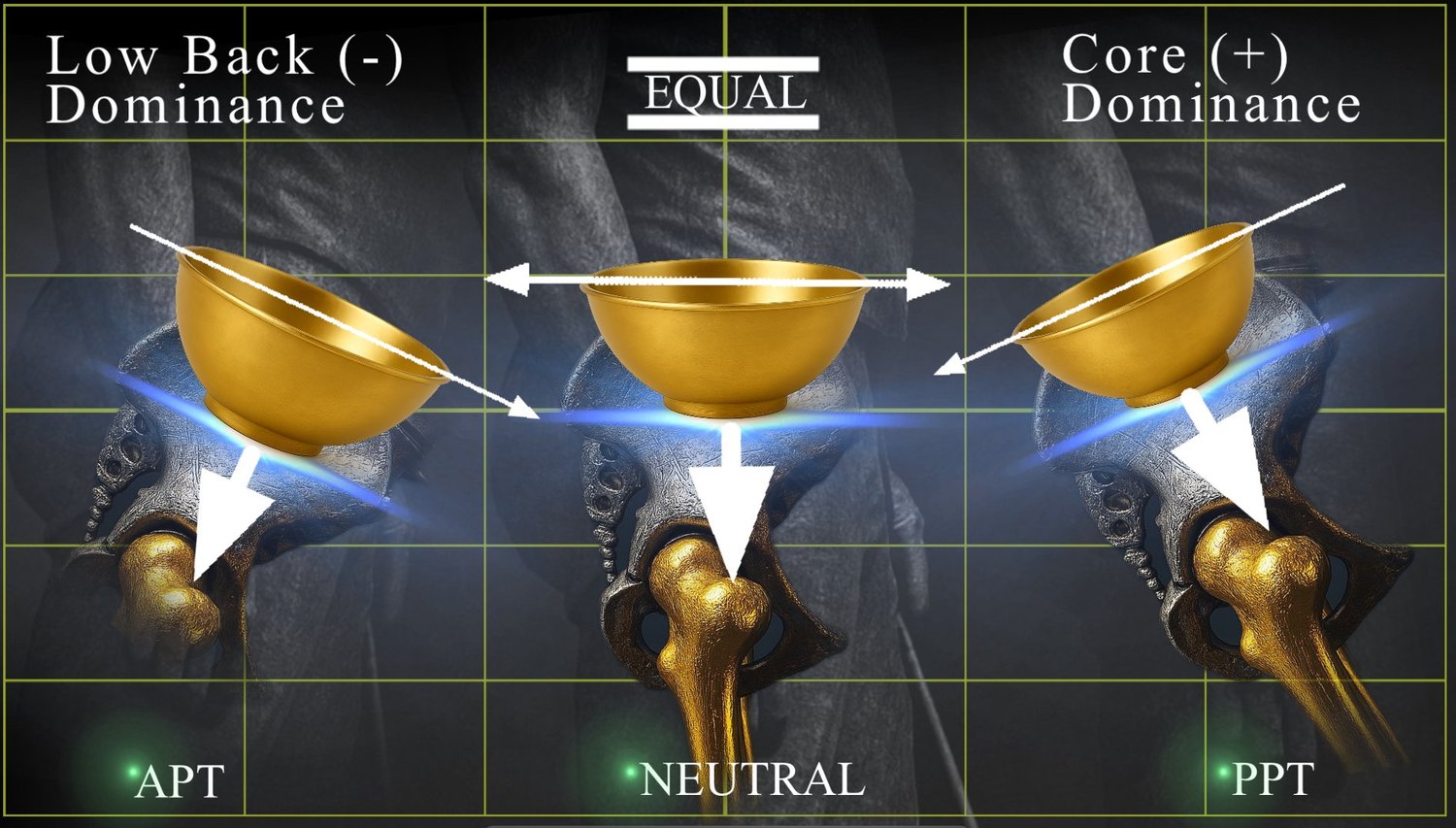
Core Inward (The Anchor): The abdominal wall pulls toward the spine, locking the pelvis into a neutral tilt and preventing collapse at the top.
Core Outward (The Engine): The core shifts into radial expansion, throwing the shoulders into rotation and generating the Ground Reaction Force required for maximum speed.
IV. EYES FOLLOW IN ORDER
Instead of seeing a blur, train your eyes to follow a specific order. When you watch the body move from the ground up, the swing starts looking like a rhythm.
V. TRACING A MOVING BODY
Apply surgical discipline on the tee. This drill trains the eye to detect the exact moment the sequence breaks and teaches the body to obey the correct order.
1. One Part Per Swing: Pick just one body part and follow it from takeaway to finish. This is how your eyes learn the sequence.
2. Reverse the Trace: If a shot goes wrong, retrace the movement backward from the outside in: Arms, Shoulders, Ribs, Pelvis.
3. Find the Bone: Let the awkwardness reveal itself. Do not fix the hand; fix the hip. Do not fix the club; fix the core.
When your vision locks onto the correct structure, the flicker disappears. Precision replaces effort.
Prequel Before the Swing
We hit the first tee and the banter dies instantly. A well shaped, fit woman is already there, standing over a ball in minimalist gear. She is noticeably vibrant, and her fragrant scent drifting through the crisp morning air is strangely familiar. My friends are not just checking her out; they are dissecting her swing mechanics as she prepares her stance.
"Look at that heel lift," one of the guys whispers, leaning in. "Pure baseball style. I should probably tell her."
"Don't even think about it," I cut him off. "No unsolicited advice. She looks like the type who will bet you big perks on the farthest distance and take your house. Trust me, zip your wallet."
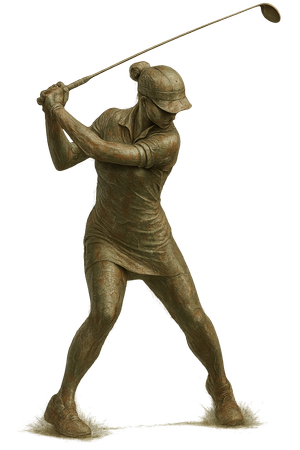
She starts her backswing. Her trail heel lifts high, an unconventional move like a baseball player loading for a home run, building a coil of pure, lethal torque. Then, with a violent but perfectly controlled snap, she thwacks the ball. The strike is so powerful the sound echoes off the trees. Before she even finishes her follow through, she speaks without turning her head.
"Hi, honey."
I freeze. It is my wife. She stripes it 300 yards dead center and does not even look back. I spent an hour acting like a ninja, and she is already here, outdriving the field.
Don't Be Afraid, You Are Not Alone
By the second hole, the tough guy act had crumbled. The friend who roasted me stared at his watch, face pale. A notification showed his wife at the club’s juice bar: "Finally got the house to myself! See you at lunch, boys!"
"She let me sneak out," he whispered. "She even left the garage unlocked so I would not wake her."
"Mine pre-packed my lucky socks while I was stealthily cleaning my irons last night," another muttered. "They were not sleeping; they were just waiting for us to clear the driveway so they could start their own spa day."
My wife waved from the next fairway, giving them that same knowing wink.
"Whatever," he muttered, finally cracking a smile. "At least she did not keep the keys under her pillow."
⚓ The Verdict: The Observer’s Final Word
The Evidence: Standing behind a player, you no longer chase the clubface. You see the tilt arrive too early or the brace fade too soon. The mystery dissolves because you are reading the swing like a map.
The Ruling: The Epicenter is the base; the rest is just the delivery. The swing is a pulse: inward to set the line, outward to hit the mark. When you observe from behind, the swing reveals its truth. The sequence becomes readable, the intention becomes visible, and the motion becomes inevitable.
CASE CLOSED.
🔗 Attentional Focus & Motor Learning
Verified peer-reviewed research on how visual sequencing and external focus direct motor perception and coordination.
- Wulf et al. (2013): Comprehensive review proving that an external focus of attention enhances motor learning and neuromuscular efficiency.
- Attentional Focus Reviews: Evidence showing that focusing on movement effects rather than body parts produces superior automaticity in sports skills.
- Quiet Eye Studies: Research confirming that a stable "Quiet Eye" period before movement is the hallmark of elite-level motor performance.
- Observational Learning: Scientific evidence that modeling movement visually prior to action creates a precise cognitive blueprint for execution.
- Motor Learning (2024): Latest research on the role of visual scanning and attention stages in the retention of highly coordinated athletic skills.