THE CORE SECRET
One Simple Move for Massive Distance and Dead Aim-Putting.
Entering Part 4
You have built stability. You have learned how to hold your ground, how to stop wobbling under pressure, and how to keep your structure steady when the swing begins to load. Part 3 gave you the anchor. Now you step into the phase where power is created from the inside.
This is where the engine wakes up.
Internal Fuel is not about strength. It is not about effort. It is about choosing the right pattern that lets the body create power without strain.
Every golfer has a power source. Some rely on the back. Some rely on the core. Most never realize which one they are using, and even fewer know how to choose the one that protects their spine and sharpens their strike.
Part 4 reveals that choice.
This is where you learn how pelvic tilt shapes muscle activation, how the body selects its internal engine, and how the right pattern turns chaos into rhythm. When you choose the wrong pattern, the swing feels unstable, the back tightens, and power leaks. When you choose the right one, the body feels organized, the strike feels centered, and the swing finally makes sense.

Status
If you can feel your base holding steady and your posture no longer collapses when you breathe in, you are ready for this phase. If your balance still drifts or your hips feel uncertain under load, stay with Part 3 until your foundation stops searching for stability.
Part 4 requires internal clarity. You are choosing your power source. Nothing less.
In Chapter 8, you discover why the core prefers simplicity, why too many cues weaken activation, and how tilt becomes the switch that organizes the entire chain. You learn how to select the pattern that fuels your swing, protects your spine, and delivers power without strain.
This is where the engine becomes yours. This is where Internal Fuel begins.
You may now proceed to Chapter 8.
|
PART 4: INTERNAL FUEL Choosing Your Power Source |
|
| Chapter | Title |
 8
8
|
The Pelvic Power Lock: Choosing Muscle Activation |
"Your power source decides your swing long before your technique does."
CHAPTER 8
PELVIC POWER LOCK
Choosing Muscle Activation
Every golfer has a default power source. Some pull from the arms, some from the legs, and some from the hips. But the most consistent and injury resistant players pull from the core. When the core becomes the primary engine, the swing becomes smoother, more predictable, and far easier to repeat under pressure. This chapter shows you how to choose the right muscle activation pattern so your body produces power the way it was designed to, not the way habit has forced it to.
I. THE COGNITIVE FILTER: THE APPLE METAPHOR
The greatest threat to your golf game is Information Overload. If your mind is fed too many technical thoughts, your body chokes on the complexity and your rhythm evaporates. Think of instructions as apples. A few apples of knowledge are enough to fuel a great swing. Try to eat the whole basket and you will not be able to move. To achieve a state of flow, you must limit your inputs to these simple cues:
The Ignition: Simply say Core In.
The Maintenance: Maintain that inward pressure from the start of the swing until the ball is gone.
The Follow Through: After the hit, give yourself one final reminder: Do not let go.
II. THE STRUCTURAL BREAKDOWN
Viewing the body as a high performance machine, it becomes clear that the pelvis is the steering wheel of the spine. Biomechanical research by Hosea et al. (1990) proves the spine must absorb up to 1,600 pounds (720kg) of force at the moment of impact. The way you tilt your pelvis determines if that massive energy is funneled into the ball or absorbed as structural damage by your vertebrae.
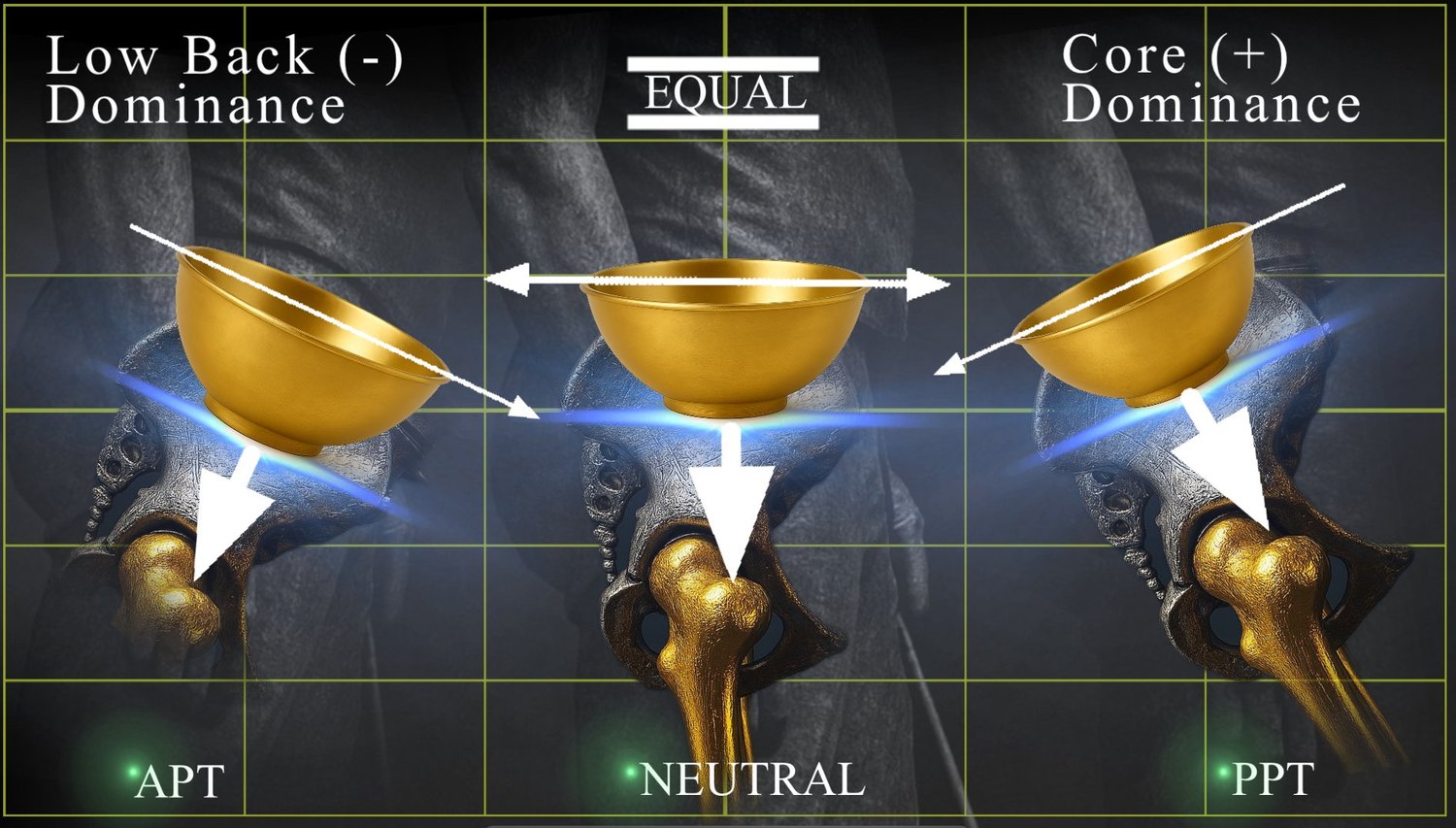
On the practice tee, pelvic tilt acts as the hidden switch that organizes the spine and core during the golf swing. This table captures the two primary tilt patterns: anterior and posterior. It shows how each pattern shapes movement, balance, and rotational power. By seeing them side by side, you recognize how tilt changes posture, influences spinal load, and either unlocks or limits core engagement.
III. GOLF SWING PHASE CALIBRATION
Proper tilt and pelvic positioning throughout the swing is essential to maintain core engagement, protect the spine, and ensure efficient energy transfer. At setup, a quiet ribcage over the hips awakens the core; during the backswing, posterior tilt steadies rotation and keeps the spine long; in the downswing, leading with the core allows the pelvis to re-center and power to flow cleanly; and finally, over-bracing with excessive posterior tilt can lock the pelvis, limiting mobility and rhythm, which can be remedied with subtle anterior adjustments. Phase-by-phase calibration ensures posture, rotation, and tilt work together to preserve both performance and structural integrity.
Adress
Setup is the moment where tilt defines posture and prepares the body for motion. This table compares anterior and posterior tilt at address, showing how each position changes the look of the stance, the feel of the spine, and the readiness of the core. By studying these contrasts, you can see how one setup appears athletic but leaves the core passive, while the other braces the system and stabilizes rotation before the swing begins.
Note: Setup posture is the foundation of the swing. Anterior tilt may look athletic but leaves the core passive, while posterior tilt braces the spine and stabilizes rotation.
Backswing
Use tilt to shape the coil. With anterior tilt, the spine arches, the hips spin loosely, and rotation drifts toward the spine. The club lifts off plane and the motion scatters. With posterior tilt, the spine stays long, the ribcage turns smoothly, and rotation anchors. The load centers with clarity and the body feels ready to release.
The table below highlights the contrast. One pattern scrambles energy. The other compresses it into a coil you can trust.
Choose the tilt that keeps posture steady and the coil clean. Anterior tilt often drives the spine into an arch and breaks rhythm. Posterior tilt steadies rotation, reduces lumbar strain, and holds balance.
Downswing
Let the core lead the strike. With anterior tilt, the pelvis remains forward, the wrists tighten, and torque climbs into the spine. The hit feels late and the face wobbles. With posterior tilt, the core fires first, the pelvis re-centers, and energy moves cleanly through the chain. The face steadies and the ball takes the full transfer.
The table below shows the contrast. One pattern scrambles late. The other delivers power on time.
Choose the tilt that sends strength through the core and keeps the face calm. Avoid the late scramble. Keep the coil tight, lead with the core, and let the ball feel the full load.
Impact Phase
Impact is where the body’s preparation meets execution. The Epicenter leads the strike, stabilizing the pelvis and spine while the clubhead absorbs the stored energy. A proper core brace ensures power transfers efficiently, protecting the joints and producing consistent distance.
Pelvic tilt and core engagement determine whether the swing delivers clean energy or leaks force through the spine and arms.
Let the core guide the strike. Lead with the Epicenter, keep the pelvis stable, and allow energy to flow through the chain. Avoid leaking force and let the clubface feel the full, controlled transfer.
Follow-Through
Finish with a body that breathes. With anterior tilt, the finish stands tall but carries tension in the low back. The posture looks proud and feels tight. With posterior tilt, the pelvis re-centers and the spine decompresses. Balance returns quickly and the body starts recovery as the club slows. The table below shows the difference. One finish holds stress. The other releases it and restores control.
Pick the finish that lets the body exhale. Re-center the pelvis, release the spine, and carry balance through the last frame.
When APT Can Help
Sometimes the body locks too far into posterior tilt. A slight forward tip of the pelvis restores mobility, frees rotation, and reduces stiffness in the hips and spine. The table below shows how introducing APT can create balance, improve flow, and prevent the body from bracing too tightly. Tilt works as a flexible tool that coaches and players can apply with precision to unlock rhythm and movement.
When PPT Becomes Too Much
Posterior pelvic tilt protects the spine and anchors rotation. However, when held too tightly, it locks the body and restricts freedom. The table below shows how easing the tuck restores mobility, lets rotation flow, and brings balance back. PPT works best as a dynamic cue that adapts to each phase of the swing.
IV. CHOOSING THE PATTERN FOR YOUR SWING IDENTITY
Pattern selection means aligning tilt with the rhythm of your build. The best pattern feels natural, repeatable, and pain-free.
- Core-Dominant Swingers (The Speed Frame): Rely on abdominal, glute, and hip flexor coordination. Requires high levels of PPT control to maintain the "Stability Anchor" at high speeds.
- Back-Dominant Swingers (The Power Frame): Use spinal extension, lat strength, and posterior chain rhythm. Often benefits from a slight APT strategy to support the rotation of a larger physical frame.
THE OBSERVER’S FINAL WORD
Tilt is a living cue. It is a flexible tool that evolves with goals whether you seek compression, launch, or recovery. PPT works best as a Dynamic Cue, adaptable and fluid, never frozen. Set the pelvis to protect the spine, but let it move naturally to preserve the fire.
Comfort over conformity. Feed the core only the apples it needs to stay ignited. Brace for the strike, but exhale through the finish.
🔗Research
The following peer-reviewed research examines how muscle activation patterns influence swing efficiency, power generation, consistency, and injury risk in golfers.
- Gluck, Bendo, and Spivak measured trunk muscle activation during rotational sport movements and demonstrated that increased core engagement reduces lumbar stress while improving force transfer.
- Hume, Keogh, and Reid identified that skilled golfers rely on coordinated trunk and pelvic activation rather than isolated arm or shoulder effort to generate clubhead speed.
- Neal et al. demonstrated that proximal muscle groups initiate force production, with the core playing a central role in sequencing energy toward the club.
- Myers, Lephart, and Tsai found that golfers with poor core activation patterns compensate with excessive arm and shoulder effort, reducing consistency and increasing injury risk.
- Kwon et al. showed that efficient swings rely on early trunk engagement, while delayed core activation shifts workload to distal segments.
- Sorbie et al. reviewed golf biomechanics literature and concluded that core-driven movement patterns are associated with improved performance and reduced injury incidence.
⚓Summary
Core in is the simplest cue in golf. Say it, feel it, and keep it alive through the swing. Too much information overloads the athlete, but a few apples of knowledge are enough to guide posture, balance, and rotation. Pelvic tilt becomes the master switch that decides whether the swing feels stable or chaotic.
Posterior tilt unites core and glutes into a stable base. Anterior tilt unites hip flexors and low back into a pattern that often compresses the spine. Tilt shapes balance, influences loading, and determines whether rotation feels centered or scattered. When tilt matches the moment, the swing gains rhythm, protection, and clarity.
Across the swing, tilt becomes the silent architect. Posterior tilt builds stability. Anterior tilt loads the coil. Balanced sequencing transforms tilt into rhythm. When the body learns to shift tilt with purpose, the spine stays safe, the strike sharpens, and endurance rises.
IGNITION DRILL
- Stand in your setup and soften your knees. Add a light posterior tuck until your ribs settle and your lower back feels flat. This is your braced foundation.
- Make a slow backswing and allow a slight anterior tilt to help you coil. Feel the load gather without strain.
- From the top, shift gently into a posterior tuck as you begin the downswing. Let the core lead and keep the pelvis centered.
- Hit a small set of half shots while matching tilt to the phase. Slight anterior to load, slight posterior to release, steady core through impact.
- Finish with a few swings where you hold your finish and re-center the pelvis. Feel the spine decompress and balance return.
NEXT
- With tilt now understood as the architect of balance and rotation, the next chapter explores how turbo hips and steady core must synchronize to prevent crash landings and unlock professional grade sequencing.
“I’ve been playing golf for over 20 years, and I’ve never come across instruction like this. Most of the books I’ve read were way too technical, full of jargon that didn’t stick. This one was different. My coach recommended it, and right from the start it felt hilariously logical, with practical applications I could actually use on the course. The humour lit up the mechanics of the swing in a way that made me laugh and remember at the same time. The writing is easy to follow, and it kept me turning the pages because it felt like someone was talking to me, not lecturing. Every metaphor in the book is unforgettable. They’re vivid, they stick in your head, and they make the biomechanics simple to feel and apply. The Core Secret: One Simple Move for Massive Distance and Dead Aim Putting is brilliant and genuine. The practical usage is impossible to forget.”
Derek Miles, Dubai UAE